Wednesday, October 17, 2012

broad horizons: my relationship with the fiction of doug tennapel


by Jason Farrell

A rubbery body.   A determined look, one bulging eye noticeably larger than the other.  A dashing, daring hero with a robotic suit and a ray-gun who also happens to be the most innocuous and least daring of all creatures: a worm.  This was Earthworm Jim, a 1994 Super Nintendo video game, and my first exposure to the wacky, and yet remarkably consistent, mind of Doug TenNapel.

I wouldn't know TenNapel by name for nearly another decade, but his distinctive creative vision stood out even on shelves full of brightly colored boxes jockeying for attention.  It's hard to get that image out of your mind once it's in there, and even the game's title is perfect in its madcap simplicity.  It's as ridiculous a concept as you're likely to come across, even in a genre defined by over the top ideas, and yet it's also oddly grounded.  While the protagonists of other platformers had superhero names like Rayman or Sonic or Megaman, this space faring worm was known simply as Jim.  The amount of character development afforded by a 16 bit cartridge in the mid '90s was necessarily limited, but Jim, for all of his whip cracking, gun shooting, earthworm headed ways, was still just an ordinary guy.

I still love video games, but comics are my first and greatest love.  Turns out that also seems to be true for Doug TenNapel as well.  He's had a long and successful career in gaming and animation (among other pursuits), but some of his most prolific output has been in the realm of graphic novels where he puts out about one full length graphic novel per year.  I've been reading them nearly that long, and he's still mining the territory where the ridiculous and the ordinary meet as effectively as he ever had.  Even when there are more brightly colored books jockeying for attention on the shelves of bookstores and comics shops, his work still stands out.

Here's a punchline you probably didn't expect:  Supposedly, I should hate Doug TenNapel's work.  Or at the very least, i should avoid it like the plague.

There are a few things that TenNapel is known for.   His art style is instantly recognizable:  thick lined, gangly, exaggerated figures, with jaws that drop several inches further than looks comfortable, and limbs that stretch and bend in near impossible ways.  He writes about family, fathers and sons in particular, and how those bonds endure even the most spectacular trials.  He loves to create and draw bizarre creatures, often the result of ordinary, harmless creatures being mashed together or mutated in newly deadly ways.  And, as has been heavily reported by many who discuss his work, there is often a significant spiritual component to his stories.  Doug TenNapel himself is a practicing Christian, and themes of morality, conversion and faith pervade his stories.

I'm not a Christian.  I'm not a religious person at all.  I'm an atheist, and while I try not to discriminate against any belief system that is not actively antagonistic to life or free thinking, I am fairly sensitive to dogma, and to proselytizing of all kinds.  I'm not interested in fiction that tells me how to feel, how to act, or how to live my life.  Tell me about your characters, authors, and their lives, and let me draw my own conclusions.  If it's heavy handed, if it sacrifices plausibility and narrative momentum and the humanity of characters in favor of serving an ideological agenda, it's no longer fiction.  At the very least, it's no longer fiction I have any time for.

It had been fully ten years since I'd read my first TenNapel book which was Creature Tech, which i then re-read in preparation for this article.  I remembered it as a funny, slightly mad romp, with the kind of imaginative blend of weird technology and mutated creatures that populate most of his work, along with strained familial relationships, hope, and a generous dollop of bathroom humor and silly puns.  Somehow, I didn't remember religion or faith playing a major role in the story's themes.

And yet, there it was, everywhere.  It wasn't subtle: at one point late in the story, our protagonist Dr. Michael Ong is transported by a symbiotic creature that has grafted itself to his chest (replacing his heart in the process) to a mysterious alternate dimension.  There, a similar creature is stretched out on a frame, its four limbs nailed to the corners like Jesus on the cross.  As he gazes up at the creature, a previously agnostic Michael is converted before our eyes.  He's returned to Earth, his chest completely healed, and when his religious father remarks on his transformation with surprise, Michael simply says, “I got saved, Pop!”

There are other religious elements as well.  The macguffin that is sought by the evil space eel riding villain of the story, Dr. Jameson, as well as by our heroes, is the Shroud of Turin, the burial shroud of Jesus Christ, an artifact thought to be capable of healing injuries and illnesses up to and including death itself, a legend proven true as the story progresses.  So, how is it possible that I missed this?   That I could be that inattentive a reader beggars belief.

And indeed, it's not that I missed the spiritual elements of this story (or in any of Doug TenNapel's work) as to some degree or another they are present in them all.  What I found is that it didn't matter. The humanity and humor with which TenNapel approaches his subjects, and the principles that he stands for behind whatever trappings, religious or otherwise, they're dressed in, are principles that I wholeheartedly believe in: family, individuality, thinking for oneself, multiple belief systems co-existing in harmony.

Frequently, TenNapel shows the flexibility in his worldview for both many different views of religion, as well as differing methods for achieving our (limited) understanding of the universe (empirical, spiritual, etc.)  There is a lack of judgment about which is superior or “right,” provided that the belief system in question allows its adherents to maintain their individuality.  It's only when a belief system threatens to overwhelm its members with a 'Invasion of the Body Snatchers' like group-think that the author's own disapproval is evident.

In Creature Tech, Michael Ong is a scientist, as is his primary assistant, Jim.   Jim is a long way from Levi, the kooky proprietor of a museum of the weird, who thinks that a dried up cinnamon roll has the face of Jesus.  He is, as Dr. Ong calls him, “one of the smartest guys I've ever met.”  When Jim attributes his intelligence to being “god-given”, Michael accuses him of using God as a crutch, and reminds him that many of the world's stupidest people believe in God.   He also tells him that “a good scientist doesn't mix his personal beliefs with research.”  Jim response to that is repeated, in some form or indirectly, again and again throughout TenNapel's work.  “That's not science by definition,” Jim tells him, “It's stupid to research a problem then arbitrarily restrict the options available to solve that problem.”

Later, Michael has an argument with his father over a similar subject, and tells him essentially that he isn't smart or educated enough to debate with Michael on the subject of science.  When told bluntly by his son to choose God or reason, his father tells him that he chose God because of reason.  The message, again, is not that theology is superior to science, but rather that one shouldn't supercede the other; the acceptance of God is not a tacit rejection of logic and reason, or vice-versa.

In Cardboard, TenNapel's most recent published work, a Mr. Wing-like old man named Gideon sells a down on his luck contractor a cardboard box which turns out to have...unusual properties, shall we say.
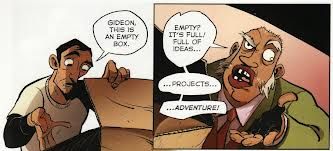
Whatever the cardboard is used to make becomes fully sentient (if the creation would normally be sentient in its flesh and blood incarnation).  After complications with the cardboard ensue, Mike confronts Gideon, demanding answers.  An increasingly bemused Mike is told, in turn, that the cardboard was made by an alien species, who were also wizards, who were also particle physicists, who were also religious.  Exasperated by these slippery definitions, Mike storms off in a confused huff.  Once again TenNapel demonstrates his idea that many different ideologies can share a harmonious co-existence, even if our stubborn brains are often unwilling to easily accept it.

Similarly, TenNapel's idea of humanity isn't limited to biological humans, and their spiritual life isn't limited to a Christian idea of heaven (with chubby, harp playing cherubs and puffy, white clouds).  They're in there: near the end of the western Iron West, the sheriff dies defending his town, and we see him next sitting on just such a cloud (although angels, chubby or otherwise, are not in evidence.)  True to TenNapel's inclusionary ideals, however, there are several other beliefs systems and afterlives in evidence throughout his work.  In the same work, a shaman calls upon “The Great Spirit” to heal protagonist Preston Struck, news Struck receives with equanimity.

In Creature Tech, a two legged mantis creature dubbed “Blue” by the locals suffers a seemingly fatal wound before being revived.  In the meantime, we're given a glimpse of the insect heaven he ends up in, a place that looks very much like Olympus with more antennae.  In the methods of his recovery, we see more evidence of TenNapel's egalitarian approach, as well as his lack of force feeding us answers:  Michael Ong uses science to try to save him, while his father appeals to a higher power.  When Blue rises, gasping, back to consciousness, we're left to decide on our own which method proved effective.  It would probably be most in the spirit of his work to decide it was a bit of both.

In Ghostopolis, the title dimension is a kind of purgatory that lies between our world and a more traditional Christian heaven, which is only hinted at.  Although ruled by evil mummies, goblins and their overlord Vaugner when our story opens, it is not, by definition, a place for the wicked.  Claire, a ghost, not only exists in TenNapel's cosmology, but ends up being voted to be the new "Lord of the Afterlife", taking over for the defeated Vaugner.  And she does so with Frank Gallows, one of the primary protagonists of the story, at her side.  This world of skeletal horses and werewolves is not just a way point for the seeker on his or her way to that land of clouds and cherubs, but a worthy destination in its own right.
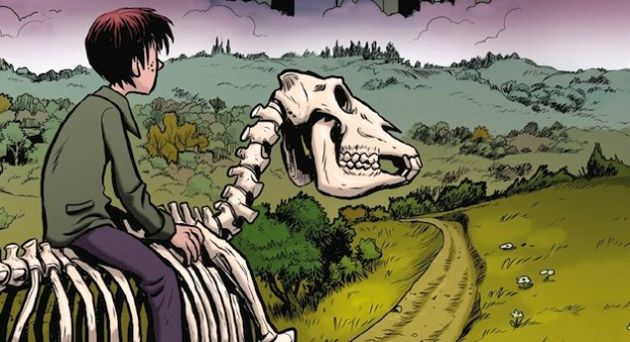
All of these different creatures, and many more, possess their own nobility and purpose in TenNapel's broad universe.  The heart and faith of a confused boxer made of cardboard is no less valid than that of a human preacher.   His characters are very often unsure, even wounded, but as long as they are grasping toward understanding, they have his sympathies.  The search for truth is not a competition with winners and losers, but rather a pursuit that all thinking beings must undertake.  This is a journey that has, for TenNapel, as many different approaches as there are thinking beings.  As I mentioned before, it is only those who threaten to stifle this curiosity, this search for truth, who are overtly “wrong” in his stories.  The mechanical army in Iron West, machines that consider humanity “stupid, lazy and inefficient.”  The worker drone-like creatures in Cardboard, who seek to plaster their favorite material over everything, smothering it.  The bugs in Earthboy Jacobus, who are so alarmed by Jacobus' ability to withstand their brainwashing that they dedicate decades to tracking down a single boy.  These are the enemies in Doug TenNapel's fiction, that is a message I can get behind.

Despite the strength of TenNapel's characterizations, his amazing, fluid, vibrant drawing, the diversity of his settings, the imagination brimming from every page, his humor, and his heart, I wouldn't have been able to overlook a core message of “this is wrong and this is right; this is the proper way to live.”  That's a message of exclusion, of narrow mindedness, and it couldn't be further from what TenNapel stands for, as evidenced again and again in his considerable body of work, a world big enough to include whale airships, pet Tyrannosaurs, islands made from interstellar princes and, thankfully, every one of us.

Monday, October 15, 2012

diary of a guttersnipe 10/15/2012: I don't know what this is about, but god damn am i handsome

by Shawn Starr

"Fuck you, you're on my time ticket"

Mini-Reviews


Flayed Corpse (Oily)
by Josh Simmons

It would be simple enough for Josh Simmons to draw a series of gory images over twelve pages and call it a day, its something he excels at, but Simmons (as always) adds additional layers to his work, and this is something that distinguishes him from other horror artists. Simmons can be as disturbing and horrific as everyone else (more so in fact), but by including the seeds of something more lofty, Simmons forces his stories into the readers sub-conscious which makes them linger long after the final page has been turned.

The standout element of 'Flayed Corpse' is Simmons use of dialogue to tell two stories at once, layering them around a single event, an autopsy, creating both a grotesque, if not by the numbers, examination of a mutilated corpse and a commentary on philosophy and science, and their relationship to humanity.

This layered narrative begins on the first page as a mysterious voice address the other coroners "Industrial accident, I would say", commenting on the injuries the man had suffered, but also expressing a decidedly Marxist critique, which is further drilled home by another shadowy figure remarking that the marks more so resemble those caused by an angry mob wielding machetes. The two go back and forth over the next four pages, conceding some points while bringing up new ones (racism, self reliance, etc) until a third figure interjects saying that they are both right and wrong, the man was tortured, burned, ground up, beaten, and hung, but it was both of their actions that lead towards these injuries.

This third voice, has a definitive tone to it, in both discussions (the political and spiritual) being ceded the final word. By setting this story in a scientific facility Simmons seems to be stacking the deck in favor of this third voice, but his answers are no less cruel than those produced by the other figures, if not more so, due to their calculated and sterile tone. His final statement, combing the two theists ideas (like previously) of the after life "Neither of you are exactly right, or wrong" with one rooted in quantum physics, "He died terrified, in agony And it echoed out and was absorbed into a universe already sick with pain". This "educated" answer becomes a far more troubling and disturbing fate than either of the other options on their own, even the tortures mentioned by the Marxist/Capitalist were less horrible than their existence in tandem.

What Simmons never does though is push the readers sympathy towards any of these "options", by only showing the coroners in silhouette, Simmons doesn't allow the reader to identify with them in any way. Instead Simmons humanizes the corpse, who looks to be pleading for an end to it all on every page. Opening on the corpses face, Simmons depicts him in deep pain, his only visible eye seems to almost be crying, all this while the coroners argue overhead, this is followed up with an clenched hand that looks to be shouting for help to a group that never wanted to help him in the first place, only discuss his suffering in the abstract. Even in a moment of empathy, when one figure says "At least we know his suffering is over" the statement is only used to launch into the next argument, not mourn what had happened.

You can purchase 'Flayed Corpse', by Josh Simmons, at the Oily Comics website here.

Cop Comics #1 
by Michael DeForge, Patrick Kyle, Mickey Zacchilli

Three of alt-comic's current crop of top cartoonists riffing on the macho cop archetype of the 80's and 90's ends up being one excellent 18 page comic.
The End of the Fucking World #1-11 (Oily)
by Charles Forsman

In addition to 'Flayed Corpse' from Oily Comics, I also read all of the currently published issues of publisher Charles Forsman's 'The End of the Fucking World' which is one of the best single issue comics coming out currently in both mainstream and independent comics (his only real competition is essentially just Brandon Graham and compatriots run on 'Prophet').

Each issue is a prefect example of a crafting a sustained narrative while still producing a satisfying single issue, all in just 8-pages. It's an interesting and captivating re-imagination of 'Bonnie and Clyde' seen through the eyes of a modern day teenager. They're bleak and cynical and pure expressions of teenage angst, but never straying far from the horror at the heart of the story.

I'll write something longer on it at a later date (maybe a dialogue of sorts) but for now all i will say is you should be buying these comics, because i was late to the party and regret not jumping in earlier.

Negron (Picturebox)
by Jonny Negron

'Negron' coming out the same month as Chris Ware's 'Building Stories' seems almost poetic, both books represent a dramatic change in the future of print (and comic) publishing. 'Building Stories' produces a story that can only be told in print; its ambition precludes any other format. 'Negron' on the other hand is the first book that is neither a collection of comics, nor art, but instead exists as a proto "Tumblr book".

There have been collections of webcomics before, but they exist in the century old newspaper strip format that requires no updating, and there have even been art books based on internet archiving, but they are simply mimicking the art books that have come before them, while "Negron' is something else entirely: a pure reflection of social media and blogging's effect on art and comics.

Every illustration in this book, even those few that are left uncredited, are forceful enough in their unique vision that they can only be identified as a Johnny Negron drawing. A prerequisite for artists to avoid the incessant need of Tumblr users to crop out credits while re-blogging. Negron's rise in internet popularity isn't solely based off his talent, it's his identifiability. A Negron comic or illustration is a Negron comic or illustration.

The books formatting goes even further to highlight its linkage to Tumblr, first by linking to Johnny Negron's Tumblr in the credits page (his sole venue for contact), but it is also designed to mimic Tumblr's stream of conscious nature. Every page flows from one Negron obsession into the next, creating an intimacy between every page, that isn't felt in any art books, because Johnny Negron curated this book over the course of a years output, not by an academic three centuries later.

'Negron' IS the next step in publishing the internet.


----------------------------------All DAY aLL cAGE-----------------------------------------------


----------------------------"I'm a vampire! I'm a vampire! I'm a vampire!"-----------------------------

My fellow Cboxer's finally posted their new episode with Tim Callahan, the one time host of The Splash Page Podcast (which is still, to me, the best comics based podcast in existence) and i think the most important comic critics of the internet era. The episodes central theme is "who the fuck cares?", and walking away from it, i don't know if i have an answer.

If you ever wondered what kind of people show up to an Adrian Tomine signing at Harvard, the answer is exactly the kind of people you think would, plus my unshaven pudgy ass.

J.J Abrams has a quote on the front of 'Building Stories'. Seriously. That is in no way a selling point.

If Joe Casey writes a Ben Marra comic i'm pretty sure my brain will explode in post-empire confetti.

I've been contemplating what will appear on CBR's Top 100 Comics of 2012 a lot lately, as this year in particular is a down year for the mainstream (that is for me and everyone i care to talk too or read regularly). Everyone seems to be experiencing a massive lull in giving a fuck about DC and Marvel past vague self hatred (aka Chad Nevett's 'Avengers vs. X-Men' reviews). I think i figured out the top two comics though, even if i wouldn't classify either one as being better than mediocre, but i don't see what else would fill these positions of sadness.

.The best comic will be 'Hawkeye' because it's the closest thing that can be compared to Waid's 'Daredevil' and comic's needs a continuity of sorts.
.The next spot will be given to 'Saga' because comics have a hard on for Brian K. Vaughn that survived the ending of 'Lost' so i doubt it will ever end, also at one point he got Fiona Staples to draw a spider lady with exposed titties and everyone is pro-that.
.The rest of the top ten will be occupied with Scott Snyder's 'Batman' (which while seeming to "crack" the CBR review breakdown never resonated past a "that's good i guess" with me).
.The rest will be a assortment of Marvel NOW! titles because Marvel is a major source of revenue along with them getting Dean White to seemingly color everything (and a couple of DC's "other titles" like 'Animal Man' which has taken 13 issues to still not get to a point)

Every page of 'Acme Novelty Library' #20 is perfect.

The perception of time in a post-internet era is really weird. Its difficult to separate original work from those influenced by it. Daniel Clowes' and Los Hernandez Brothers surely cleared the path for Adrian Tomine's career, but in a era where both creators are readily available, it is difficult to separate one from another. It doesn't help that all three are generally lumped together on panels and press junkets. It's something i see that's going to become increasingly important for critics and academics to point out as time goes on, both in comics and outside of comics.

"Suckers to the side, i know you hate my '98"

IDW announcing a 'Cerebus' covers collection is a genius level act of trolling by Dave Sim. He's still a piece of shit and i hate everything he stands for, but fucker knows how to troll.

Now I know you all wanted to know about the book fair, but i just took a bunch of pictures of woman and decided to talk about their relative level of attractiveness.

In addition to 'Flayed Corpse', Josh Simmons also made a short film. God help us if he adapts any of his comics.

Chad Nevett dropped the mic on 'Avengers vs. X-Men' while talking to Tim Callahan in this week's When Worlds Collide. Like why bother talking about that comic anymore?

I went to a Chris Ware/Charles Burns/Chip Kidd talk, afterwards their was a signing where Chris Ware said he liked my Public Enemy shirt. This caused two simultaneous thoughts, either Chris Ware was fucking with me OR at some point in the mid nineties Chris Ware was bumping "Fear of a Black Planet" while drawing 'Jimmy Corrigan'. Both are acceptable answers, but i hope it's the latter.

It's so cool Joe Casey knows who Ben Marra is.

Wednesday, October 10, 2012

episode 020: disconsolate

in this extra long episode, tim callahan (tor, cbr) returns to the show to discuss such topics as the state of mainstream comics (dc new 52, marvel now!, etc.), alan moore and neil gaiman's seminal work in mainstream comics, further thoughts on rob liefeld's exit from dc comics, hawkeye #1-2 by matt fraction and david aja, the world of rpg gaming, marvel's avengers vs. x-men event, casanova: avaritia #1-4 by matt fraction and gabriel ba, dark avengers by jeff parker with declan shalvey and kev walker, fashion beast #1 by alan moore with antony johnston and facundo percio, the film work of nicolas roeg and it's influence on alan moore (particularly 'insignifigance'), streak of chalk by miguelanxo prado, art vs. story, joe casey, the comics journal and the state of comics criticism, and much more.

music by la roux

download

Monday, October 8, 2012

diary of a guttersnipe 10/08/2012: they told me to stop being so handsome, so i told them to suck on my glock 'til it popped.


I once wrote for another site, they didn't like me that much, so i don't anymore. 

I'm here now. (Thanks Alec and Joey) 

My name's Shawn, and these are my delusions of grandeur:

Mini-Reviews

Wolverine and the X-Men #17 (Marvel)
by Jason Aaron, Mike Allred, Laura Allred

Seeing Howard the Duck in this issue kind of killed it for me, the whole story up to that point was fun and Allred's art was as always a perfect manifestation of "pop" comics; but then you flip that page and see one of the symbols of a creator getting fucked and it just felt like someone dragged Mr. Rogers into the street and beat him to death with a baseball bat screaming.

Neal Adam's Thrill Kill: Artist's Edition Portfolio (IDW)
by Neal Adams, Jim Stenstrum

I think these "portfolio" editions were designed to get people who are not completely sold on the Artist Editions to dabble in the format but a mediocre story drawn by Neal Adams that costs $30 isn't going to do that. It's insane to think anyone who would pay $30 for this would have a problem paying $100 for a 200+ page collection of Mazzucchelli art. I just don't know what the point of this book was.

New York Drawings (Drawn + Quarterly)
by Adrian Tomine

This is a book full of beautiful drawings.

Uncanny X-Force #31 (Marvel)
by Rick Remender, Phil Noto, Dean White, Frank Martin Jr.

Actively watching a comic that was once the best thing being published by Marvel, and DC (hell maybe in all of comics circa 2010-11) slowly die is a sad sight. Remender announced his departure from the book recently to conclude at the end of this arc, but it is ultimately 20 issues too late. If Remender had dropped this book after 'The Dark Angel Saga' and stuck with Opena for the whole run it would have become a revered run, as opposed to now where it's just some book that tread water trying to make 18 issues worth of story stretch to 40.

Also having Dean White color the first five pages, then replacing him with someone else just highlights how that other guy isn't Dean White.


FF #22 (Marvel)
by Jonathan Hickman, André Araújo, Cris Peter

I've noticed that artists can in no way draw age appropriate characters. Val is supposedly three but she looks eight, a similar thing happens in 'Animal Man' where Buddy Baker's well-spoken-non-genius kid is only four. I wish they would just age these kids up so their actions and rendering made any sense at all, because i get she's a genius and all, but she's three and I'm doubtful she has the motor skills to fly a jet powered toy horse across the ocean.

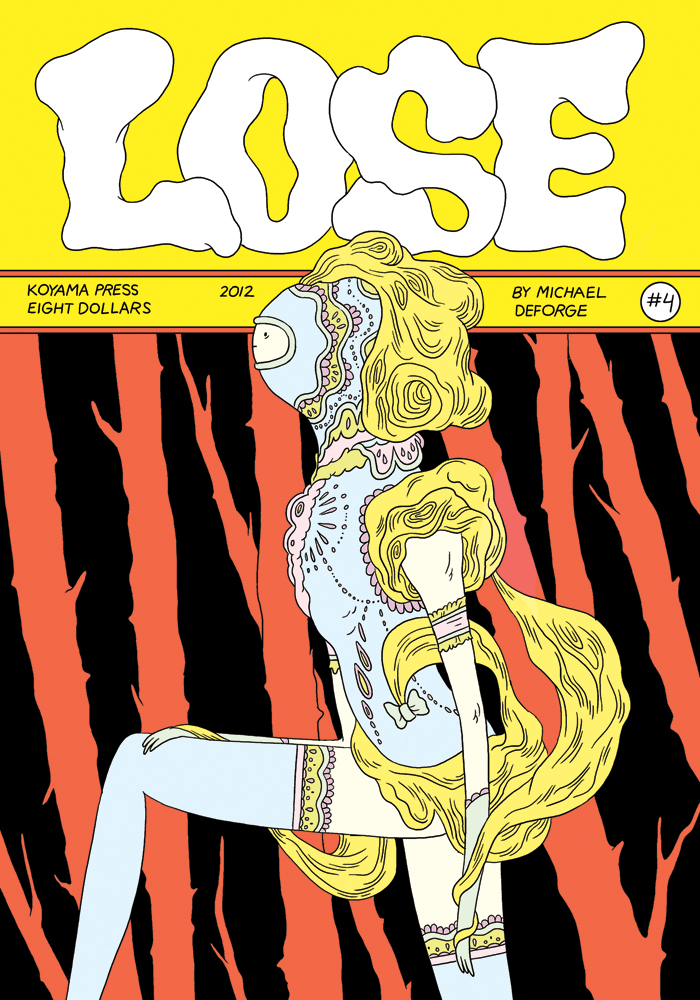
Lose #4 (Koyama Press)
by Michael DeForge

Lose #4 is the best single issue of the year.


Avengers vs. X-Men #12 (Marvel)
by Jason Aaron, Adam Kubert, John Dell III, Mark Morales, Laura Martin, Justin Ponsor (far too many people)
And to think, all they ever had to do was wish it away!

Buddy Does Seattle: The Complete Buddy Bradley Stories from "Hate" Comics, Vol. I, 1990-94 (Fantagraphics)
by Peter Bagge

This is the first volume in Fantagraphics' collections of Peter Bagge's 'Hate' comics and as a comprehensive collection it may be the best example on the comics market. Collections always seem more difficult than they should be for publishers, many are prohibitively priced (i.e. The Complete Milo Manara) which remove any chance of sampling, even if you're a fan of the work, while others edit/leave out material that would be expected to be included (Locas v1-2), and then there's simply shitty collections. These usually include no introductions, shitty paper stock, low-res scans, etc. (DC, Marvel, Checker Books, etc). 'Buddy Does Seattle' commits none of these sins (although it does reduce the dimensions of the art, but Bagge's art doesn't suffer too much from the compression), plus the collection is reasonably priced (~$15), has an informative introduction (although if you're going to spoil things in the intro I'd wish you would either label it as doing such, or place it as an afterward) (but I may be in the minority of people who read introductions before the main text) and it also has the added benefit of being a great comic.

War is Hell: The First Flight of the Phantom Eagle (Marvel)
by Garth Ennis, Howard Chaykin, Brian Reber

This is a Chaykin/Ennis joint, who you would think would collaborate more often than they do since Chaykin is essentially a more manly version of Steve Dillon, but the world is full of disappointments.

This book was done when Chaykin was hacking out work for Marvel in the late 2000's, but luckily Chaykin half-assing it with photoshopped backgrounds and 3-D models is more visually interesting than just about everything Marvel publishes so it works.

The story itself is a pretty straightforward Ennis war comic, a naive recruit realizes the horrors of war and the incompetence of leadership as he struggles to save himself and his friends. Ennis has been using this basic plot outline on just about every one of his war comics for the past twenty years, and yet it still works.


-------"You know, sooner or later every woman's bound to find out - the only thing a man's got below his belt is clay feet." ------


Bring down the Lincoln Logs of Etch-a-Sketchalism!

That Kyle Baker fella sure is funny, doing Bendis-speak ten years before Bendis broke into comics. I got his number!

The "Art of Rap: Something From Nothing" was a failure as a documentary. The problem it ran into is that it never found a narrative or theme in it's nearly 2 hour runtime, which doesn't stop it from being an interesting string of interviews (although they were limited to three to five minute chunks) but it fails to do anything grander with them.

The season finale of 'Louie' was a perfect manifestation of the series, it was both intimate and expansive, and decidedly dark and yet still the funniest show on TV.

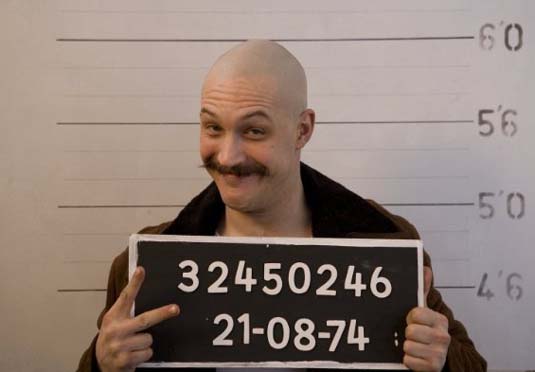
Tom Hardy pulls off the mustache in "Bronson" so hard i don't know why he doesn't have it in every film.

The Brooklyn Comics and Graphics Festival published their lineup for 2012. I don't know who half those people are, but i assume that's a fault of mine not theirs.

I've finally figured out why i don't identify with any awards show, it breaks down like this: the Emmy's are based on what your mother likes, the Grammy's are what your little sister listens too, and the Oscars are all about what your pretentious uncle defines as "serious".

"The Master" was a beautiful failure. Phoenix will win an Oscar, but the story fell apart from a thin script and poor editing. It drifted from scene to scene without purpose, and seemed to try and find a point towards the end but ended up nowhere.

I find that a large swath of criticism is based around justifying ones childhood.

The new Mountain Goats album came out this week, but I'm all out of whiskey so i haven't had a chance to listen to it yet.

Artist Editions id like to see (but probably still wouldn't buy): Howard Chaykin's 'Black Kiss'; Milo Manara's 'Indian Summer', anything by Moebius.

I'm having trouble figuring out my feelings on 'Dal Tokyo', it is essentially two different comics, the first segment (originally published in the US) has a firm narrative and rotating cast of characters for 70 odd installments, when the strip moves to Japan several years later though the narrative is dropped almost immediately (it has vague hints in the beginning but they're not followed up on) and falls into a mixture of abstract art pieces and "poetic" prose over non-sequential images. I wasn't even sure i was reading it in the right direction at certain points. Its one of those books that cant be consumed all at once, but rather piecemeal over several days, and even then it's difficult to digest. Carter Scholz has the best review you're going to find for it over at The Comics Journal, but I'm still left at odds with the work. Maybe next year.

The Chemical Box's own Joey Aulisio talks about the "Space Jam" soundtrack for twenty minutes on some other podcast this week.

If only Marvel hadn't "misplaced" all of Jack Kirby's artwork, those would make for some nice Artist Editions.

I want to buy every page of 'Black Kiss' art. If someone knows how to contact Mr. Chaykin or his art dealer, I'd appreciate it.

'Freaks and Geeks' is on Netflix Streaming now, that's one of those shows that the more removed you are from high school the harder it is to watch. I remember seeing it for the first time my senior year of high school with my brother and loving every second of it, now i watch it and cringe over how awkward and terrible everything was. Its a show that somehow becomes more personal the farther removed you are from it.

I like that that site i don't write for anymore rediscovered all the comics i was talking about six months ago. Good for them. (Can i have my non-paying job back?)

You know what, if you block quote 20% of another persons article; along with large chunks of other people articles, you really should be forced to have the article credited to "some asshole".


------To play us out, here's Dave Sim - comics greatest martyr-----


"On the Feminist side, well, no I’m not a feminist per Se. But, I think that pointing out that 50% of the world’s population is responsible for 100% of the world’s births and that that fact represents a structural flaw to feminism is just pointing out a structural flaw to a political movement. It doesn’t mean I hate women. The replacement birth rate has dropped for five successive years and that means society is on a collision course with oblivion. There is some yet-to-be-determined percentage of the female population that needs to be primarily engaged in giving birth to and rearing children in order to move the replacement birth rate back up to a point where we are actually replacing instead of exponentially losing population. I’m pretty sure it’s one of the driving forces behind the economy collapsing. Population drives the economy in a real way. If your population is collapsing so is your economy. I don’t pretend to know WHAT percentage of the female population needs to be so engaged to move us back in a more sensible direction, but I think we are way PAST whatever percentage that is, in the wrong direction. Nor am I (pace Margaret Atwood’s HANDMAID’S TALE) suggesting we need to pass laws forcing women to give birth. No, it would have to be completely voluntary and I don’t see any sign of it even becoming a topic of conversation although I think it’s a conversation we are long overdue for having as a society. If that makes me the “Adolf Hitler of Graphic Novelists” then it’s just something I’ll have to accept as the price of being in the situation to bring up subjects that I think need to be looked at that no one else is willing to discuss. Winston Churchill took a lot of flack for warning that Germany rearming in the 1930s was no small thing, but he was eventually proved right. It was no small thing. 90% of women being out in the workforce, in my view, is no small thing."

- Dave Sim, a man the New York Times don't want none of.

Wednesday, August 29, 2012

episode 019: ghosts


in this episode joey and alec discuss rob liefeld's spectacular exit from dc comics, take a look back at daniel clowes' ghost world (eightball #11-18) + lament the loss of the one-man anthology, batman incorporated #3 by grant morrison and chris burnham, the sky in stereo by mardou, scalped #60 by jason aaron and rm guera, and more.

music by rival schools

download

Wednesday, August 22, 2012

episode 018: debauchery


in this episode joey and alec chat about the end of summer, the abrupt end of butcher baker the righteous maker and the slight joe casey backlash, howard chaykin's black kiss and black kiss 2 #1, fatale #7 by ed brubaker and sean phillips, daredevil #17 by mark waid and mike allred, batwoman #12 by j.h. williams III and w. haden blackman, our recent buying habits + the current state of superhero comics (yet again), and more.

music by my bloody valentine

download

Wednesday, August 1, 2012

episode 017: dark knight discourse


in this episode joey and alec take a quick look at punk rock jesus #1 by sean murphy before diving into a long conversation about christopher nolan's 'the dark knight rises' film as well as his whole take on the batman franchise and our history with it (and there are spoilers if you are sensitive to that kind of thing).

music by hans zimmer

download