Showing posts with label articles. Show all posts

Friday, February 1, 2013

vertigo: a (premature) eulogy


The (somewhat) recent news that Karen Berger was resigning as Executive Editor of the venerable DC imprint Vertigo sent my mind spinning down the 20+ years of my own comics reading history.  I wasn't around for the beginning of Vertigo, but Vertigo was certainly around for me, and blasted the spandex covered blinders that I had worn as a teenager into splinters, forever changing my expectations for, and love of, comics.  When I first heard the news about Berger a few months ago, it felt like that journey had come to an unceremonious end, and this piece, every time I imagined writing it, felt as much an obituary as a celebration. Subsequent events have given me a bit more hope; the imprint is not being dissolved, the highly qualified Shelly Bond has agreed to take on Berger's leadership position, and the promise of continued relevance for the otherwise moribund DC comics is flickering, but not extinguished.  

So, let's stick with the celebration part.  I won't say goodbye (as I had planned to do), but those multitudinous memories, now aroused, will crowd around my brain until I release them into the wild.  There are a lot of them.

As I mentioned above, I had comics tunnel vision as a teen, exclusively reading many of the same characters and titles that remain popular today: X-Men, Wolverine, Punisher.  DC, for me, meant Superman, convoluted time lines and alternative universes, and an occasional odd duck like 'The Omega Men'.  Beyond that, I had little idea that other publishers even existed.  As I grew older, I turned to novels and movies to fulfill any desire for more challenging, more adult fare.  The 'Born Again' story in 'Daredevil' was the apex of literary merit in comics for me at the time, and I lacked the imagination or faith to realize that I was trundling around the foothills of a Mount Everest of quality, variety, and ambition.   Don't get me wrong: I still love and appreciate Born Again, but still, c'mon.  Tip of the proverbial iceberg.

I quit comics.  I thought comics had quit me.  I thought they had nothing more to offer me as I entered my high school years.  It was true that the X-Men had nothing much more to offer me at that point, but comics?  I was like a near-sighted man imagining that the horizon lay at the boundaries where my own deficient vision began to blur.

Several years later, when I was in my early twenties, I was working in a T-shirt shop that had plenty of T-shirts, but very little shopping.  I would have read cereal boxes to pass the time, it was so boring.  As luck would have it, instead of cereal, a co-worker of mine brought in a few comic books, and among them was the first issue of Sam Kieth's 'The Maxx'.  Yeah, I know: not Vertigo.  But it led me to Vertigo, and quite quickly, because it showed me a few very important truths that I had somehow been oblivious to:  not all comics were DC/Marvel, not all comics were superheroes, artwork didn't all look the same, and most importantly, comics could still speak to me.

Let's skip the part where my stupid brain led me down the well worn grooves of my complacency, and the first few comics I bought to rekindle my fizzled interest were, wait for it:  X-Men, Wolverine and the fucking Punisher.  They were as puerile as ever (in fact, in the early '90s, they were quite a bit worse than they had been before), but fortunately, I didn't stop there.  I went to a comic shop, and I discovered 'Sandman'.

What. The fuck.  Is this?  I had never seen anything like it, or read anything like it.  The first half dozen issues I bought were the only half dozen issues this little Things From Another World (different name then, I think) had in stock, so they were scattered all over the place, and part of several different story lines.  Nevertheless, I was blown away, even out of sequence.  Dream's twinkling eyes glaring out at me from the cover of #50's Ramadan.  Delirium's elliptical, fascinating nonsense in crooked letters disarranged inside rainbow word balloons.  Gaiman and Allred telling the nothing-like-comics-I-knew story of Prez.  In those half dozen issues I saw half a dozen completely different stories, and ways of visualizing a story, and I couldn't have been more awestruck if I had discovered gravity for the first time that day.

That day I also became a collector of comics for the first time.  Not the Ebay, encase my books in slabs, debate the difference between 9.4 and 9.6 kind of collector.  No, for the first time, I cared about having all of the issues of a comic book series.  I'd always been content before to buy them as I found them, skipping around, scattered issues of even my favorite series.  Not only was I determined to buy and read every issue of 'Sandman', but I was willing to pay premium prices to obtain them.   Not because I thought they'd be worth more some day, never because of that.  Because of the STORY.  I've never been addicted to drugs, but I know what it's like, because, damn it, THE STORY.  

And thus 'Sandman' became, to borrow another common addiction term, my gateway drug.  To other comics, yes, eventually.  But in those days, the blinders were hanging in tatters, but were not yet blown completely off, and I started my trip into broader awareness by checking out a ton of other Vertigo books: Milligan & Bachalo's 'Shade, The Changing Man', Wagner, Seagle & Davis' 'Sandman Mystery Theatre', Ennis & Dillon's 'Hellblazer'.  Not everything resonated, of course; the trippier, metafictional series like 'Doom Patrol' and 'Kid Eternity' felt like attempts to deconstruct those superhero comics I had so recently read unironically, and were boring, distancing and pointless to me.   I wanted new worlds, new genres, not old ones turned on their heads.

Shade did have elements of that, of course.  For me at least, the fusillade of ideas didn't overwhelm the narrative, and most importantly, the characters. At Vertigo, Peter Milligan soon became perhaps my favorite writer.  'Enigma', 'Face', 'The Eaters'... all brilliant.  And that leads me to another of the sea changes that Vertigo wrought on my relationship with comics: creators mattered.  Before Vertigo, I didn't know or care who wrote and drew the books.  I did know that Frank Miller and David Mazzucchelli were responsible for Born Again', but that was just about the only comics story that had motivated me to check the credits page.  After Vertigo, the writers and artists of the books I cared about would be my primary (sometimes only) barometer of interest in future titles.  I can't imagine things any other way, now.  Vertigo was not about creating strong concepts, and then milking them generation after generation with a parade of differently talented craftsmen, all working on the same canvas with their different tools.  Vertigo was about creation, about experimentation, about discovery.  It wasn't about doing the best you could with what you were given.  It was about creating the best thing you could to give life to your own ideas. 

Vertigo has been around for as long as I've been reading comics as an adult, and it's been as consistent or more as any other creative force over that time period.  There have been the messy "failures" along the way: 'American Virgin', 'Air', 'Loveless', 'Greek Street'.  It's a testament (that's another one, actually: 'Testament') to the consistent quality and ambitious nature of Vertigo's titles, and Karen Berger's stewardship, that even those titles I haven't, as yet, gotten into still hold some measure of appeal for me.  There are very few Vertigo titles I have written off completely.

And then there are the successes, and there are a lot of them.  Much has been said and written about a Vertigo "house style," but when I think about the diverse lineup of Vertigo titles I've enjoyed over the past two decades, the only commonality I see is a somewhat nebulously defined (at least by me)  commitment to quality.  The retro cool of the two 'Terminal City' series and the future cool of Paul Pope's '100%' and 'Heavy Liquid'. The wordless urban fable 'The System' by Peter Kuper.  Gritty crime dramas like 'Scalped' and 'Luna Park'.  Kyle Baker's particular brand of madness.  Steve Seagle's personal and affecting Superman story.  G. Willow Wilson's magical realism.  David Lapham's dance on the razor's edge.  Mat Johnson's historical dramas.  If you're a Vertigo reader, in the space of this paragraph, you've probably thought of several favorites I haven't mentioned.  It's a staggering list, by any measure.

The road that Vertigo set me on twenty years ago has since developed many forks and branches.  If Vertigo disappears tomorrow (a causality of low sales and corporate priority shuffling), there would still be a hundred different routes to the destination of vital, exciting graphic stories.  No matter the relevance Vertigo will have to my comics reading future, there is no mistaking its importance to my past.  The first comic I ever pre-ordered was published by Vertigo ('Mr. Punch').  The only long running series I have read in their entirety are Vertigo series.  Vertigo didn't just unlock the door for me, it ushered me in and guided me through the landscape of this brave new world.  Thank you, Karen Berger, and the thousands of other dedicated and creative folks who have treated their readers with respect, and their work as an art form. 

Wednesday, October 17, 2012

broad horizons: my relationship with the fiction of doug tennapel


by Jason Farrell

A rubbery body.   A determined look, one bulging eye noticeably larger than the other.  A dashing, daring hero with a robotic suit and a ray-gun who also happens to be the most innocuous and least daring of all creatures: a worm.  This was Earthworm Jim, a 1994 Super Nintendo video game, and my first exposure to the wacky, and yet remarkably consistent, mind of Doug TenNapel.

I wouldn't know TenNapel by name for nearly another decade, but his distinctive creative vision stood out even on shelves full of brightly colored boxes jockeying for attention.  It's hard to get that image out of your mind once it's in there, and even the game's title is perfect in its madcap simplicity.  It's as ridiculous a concept as you're likely to come across, even in a genre defined by over the top ideas, and yet it's also oddly grounded.  While the protagonists of other platformers had superhero names like Rayman or Sonic or Megaman, this space faring worm was known simply as Jim.  The amount of character development afforded by a 16 bit cartridge in the mid '90s was necessarily limited, but Jim, for all of his whip cracking, gun shooting, earthworm headed ways, was still just an ordinary guy.

I still love video games, but comics are my first and greatest love.  Turns out that also seems to be true for Doug TenNapel as well.  He's had a long and successful career in gaming and animation (among other pursuits), but some of his most prolific output has been in the realm of graphic novels where he puts out about one full length graphic novel per year.  I've been reading them nearly that long, and he's still mining the territory where the ridiculous and the ordinary meet as effectively as he ever had.  Even when there are more brightly colored books jockeying for attention on the shelves of bookstores and comics shops, his work still stands out.

Here's a punchline you probably didn't expect:  Supposedly, I should hate Doug TenNapel's work.  Or at the very least, i should avoid it like the plague.

There are a few things that TenNapel is known for.   His art style is instantly recognizable:  thick lined, gangly, exaggerated figures, with jaws that drop several inches further than looks comfortable, and limbs that stretch and bend in near impossible ways.  He writes about family, fathers and sons in particular, and how those bonds endure even the most spectacular trials.  He loves to create and draw bizarre creatures, often the result of ordinary, harmless creatures being mashed together or mutated in newly deadly ways.  And, as has been heavily reported by many who discuss his work, there is often a significant spiritual component to his stories.  Doug TenNapel himself is a practicing Christian, and themes of morality, conversion and faith pervade his stories.

I'm not a Christian.  I'm not a religious person at all.  I'm an atheist, and while I try not to discriminate against any belief system that is not actively antagonistic to life or free thinking, I am fairly sensitive to dogma, and to proselytizing of all kinds.  I'm not interested in fiction that tells me how to feel, how to act, or how to live my life.  Tell me about your characters, authors, and their lives, and let me draw my own conclusions.  If it's heavy handed, if it sacrifices plausibility and narrative momentum and the humanity of characters in favor of serving an ideological agenda, it's no longer fiction.  At the very least, it's no longer fiction I have any time for.

It had been fully ten years since I'd read my first TenNapel book which was Creature Tech, which i then re-read in preparation for this article.  I remembered it as a funny, slightly mad romp, with the kind of imaginative blend of weird technology and mutated creatures that populate most of his work, along with strained familial relationships, hope, and a generous dollop of bathroom humor and silly puns.  Somehow, I didn't remember religion or faith playing a major role in the story's themes.

And yet, there it was, everywhere.  It wasn't subtle: at one point late in the story, our protagonist Dr. Michael Ong is transported by a symbiotic creature that has grafted itself to his chest (replacing his heart in the process) to a mysterious alternate dimension.  There, a similar creature is stretched out on a frame, its four limbs nailed to the corners like Jesus on the cross.  As he gazes up at the creature, a previously agnostic Michael is converted before our eyes.  He's returned to Earth, his chest completely healed, and when his religious father remarks on his transformation with surprise, Michael simply says, “I got saved, Pop!”

There are other religious elements as well.  The macguffin that is sought by the evil space eel riding villain of the story, Dr. Jameson, as well as by our heroes, is the Shroud of Turin, the burial shroud of Jesus Christ, an artifact thought to be capable of healing injuries and illnesses up to and including death itself, a legend proven true as the story progresses.  So, how is it possible that I missed this?   That I could be that inattentive a reader beggars belief.

And indeed, it's not that I missed the spiritual elements of this story (or in any of Doug TenNapel's work) as to some degree or another they are present in them all.  What I found is that it didn't matter. The humanity and humor with which TenNapel approaches his subjects, and the principles that he stands for behind whatever trappings, religious or otherwise, they're dressed in, are principles that I wholeheartedly believe in: family, individuality, thinking for oneself, multiple belief systems co-existing in harmony.

Frequently, TenNapel shows the flexibility in his worldview for both many different views of religion, as well as differing methods for achieving our (limited) understanding of the universe (empirical, spiritual, etc.)  There is a lack of judgment about which is superior or “right,” provided that the belief system in question allows its adherents to maintain their individuality.  It's only when a belief system threatens to overwhelm its members with a 'Invasion of the Body Snatchers' like group-think that the author's own disapproval is evident.

In Creature Tech, Michael Ong is a scientist, as is his primary assistant, Jim.   Jim is a long way from Levi, the kooky proprietor of a museum of the weird, who thinks that a dried up cinnamon roll has the face of Jesus.  He is, as Dr. Ong calls him, “one of the smartest guys I've ever met.”  When Jim attributes his intelligence to being “god-given”, Michael accuses him of using God as a crutch, and reminds him that many of the world's stupidest people believe in God.   He also tells him that “a good scientist doesn't mix his personal beliefs with research.”  Jim response to that is repeated, in some form or indirectly, again and again throughout TenNapel's work.  “That's not science by definition,” Jim tells him, “It's stupid to research a problem then arbitrarily restrict the options available to solve that problem.”

Later, Michael has an argument with his father over a similar subject, and tells him essentially that he isn't smart or educated enough to debate with Michael on the subject of science.  When told bluntly by his son to choose God or reason, his father tells him that he chose God because of reason.  The message, again, is not that theology is superior to science, but rather that one shouldn't supercede the other; the acceptance of God is not a tacit rejection of logic and reason, or vice-versa.

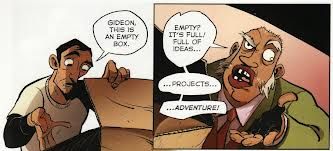
In Cardboard, TenNapel's most recent published work, a Mr. Wing-like old man named Gideon sells a down on his luck contractor a cardboard box which turns out to have...unusual properties, shall we say.

Whatever the cardboard is used to make becomes fully sentient (if the creation would normally be sentient in its flesh and blood incarnation).  After complications with the cardboard ensue, Mike confronts Gideon, demanding answers.  An increasingly bemused Mike is told, in turn, that the cardboard was made by an alien species, who were also wizards, who were also particle physicists, who were also religious.  Exasperated by these slippery definitions, Mike storms off in a confused huff.  Once again TenNapel demonstrates his idea that many different ideologies can share a harmonious co-existence, even if our stubborn brains are often unwilling to easily accept it.

Similarly, TenNapel's idea of humanity isn't limited to biological humans, and their spiritual life isn't limited to a Christian idea of heaven (with chubby, harp playing cherubs and puffy, white clouds).  They're in there: near the end of the western Iron West, the sheriff dies defending his town, and we see him next sitting on just such a cloud (although angels, chubby or otherwise, are not in evidence.)  True to TenNapel's inclusionary ideals, however, there are several other beliefs systems and afterlives in evidence throughout his work.  In the same work, a shaman calls upon “The Great Spirit” to heal protagonist Preston Struck, news Struck receives with equanimity.

In Creature Tech, a two legged mantis creature dubbed “Blue” by the locals suffers a seemingly fatal wound before being revived.  In the meantime, we're given a glimpse of the insect heaven he ends up in, a place that looks very much like Olympus with more antennae.  In the methods of his recovery, we see more evidence of TenNapel's egalitarian approach, as well as his lack of force feeding us answers:  Michael Ong uses science to try to save him, while his father appeals to a higher power.  When Blue rises, gasping, back to consciousness, we're left to decide on our own which method proved effective.  It would probably be most in the spirit of his work to decide it was a bit of both.

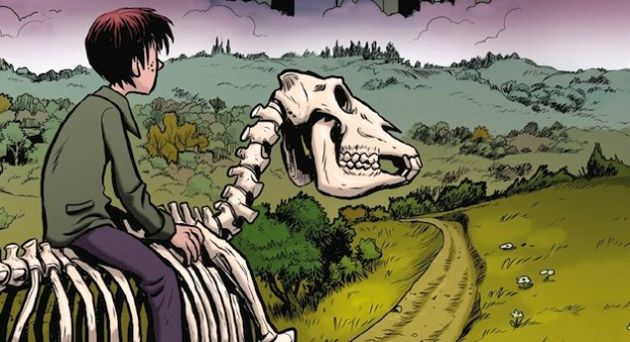
In Ghostopolis, the title dimension is a kind of purgatory that lies between our world and a more traditional Christian heaven, which is only hinted at.  Although ruled by evil mummies, goblins and their overlord Vaugner when our story opens, it is not, by definition, a place for the wicked.  Claire, a ghost, not only exists in TenNapel's cosmology, but ends up being voted to be the new "Lord of the Afterlife", taking over for the defeated Vaugner.  And she does so with Frank Gallows, one of the primary protagonists of the story, at her side.  This world of skeletal horses and werewolves is not just a way point for the seeker on his or her way to that land of clouds and cherubs, but a worthy destination in its own right.

All of these different creatures, and many more, possess their own nobility and purpose in TenNapel's broad universe.  The heart and faith of a confused boxer made of cardboard is no less valid than that of a human preacher.   His characters are very often unsure, even wounded, but as long as they are grasping toward understanding, they have his sympathies.  The search for truth is not a competition with winners and losers, but rather a pursuit that all thinking beings must undertake.  This is a journey that has, for TenNapel, as many different approaches as there are thinking beings.  As I mentioned before, it is only those who threaten to stifle this curiosity, this search for truth, who are overtly “wrong” in his stories.  The mechanical army in Iron West, machines that consider humanity “stupid, lazy and inefficient.”  The worker drone-like creatures in Cardboard, who seek to plaster their favorite material over everything, smothering it.  The bugs in Earthboy Jacobus, who are so alarmed by Jacobus' ability to withstand their brainwashing that they dedicate decades to tracking down a single boy.  These are the enemies in Doug TenNapel's fiction, that is a message I can get behind.

Despite the strength of TenNapel's characterizations, his amazing, fluid, vibrant drawing, the diversity of his settings, the imagination brimming from every page, his humor, and his heart, I wouldn't have been able to overlook a core message of “this is wrong and this is right; this is the proper way to live.”  That's a message of exclusion, of narrow mindedness, and it couldn't be further from what TenNapel stands for, as evidenced again and again in his considerable body of work, a world big enough to include whale airships, pet Tyrannosaurs, islands made from interstellar princes and, thankfully, every one of us.