Showing posts with label chad nevett. Show all posts

Wednesday, September 4, 2013

train kept a-rollin' 005: thanos rising #5


Thanos Rising #5 (Marvel)
by Jason Aaron, Simone Bianchi, Riccardo Pieruccini, Ive Svorcina

1. Growing up, I would go to family gatherings, especially Thanksgiving and Christmas, and be faced with the fact that I would have to eat the stuffing. Because I was known as the 'One Who Loves Stuffing'. And I did – I do. Well mixed and prepared stuffing is one of my favorite foods and one that I only get to eat once or twice a year. Except, my love for well mixed and prepared stuffing meant that I abhorred poorly mixed and prepared stuffing, which is what I got more often than not. I would choke it down and playact that, yes, I am the 'One Who Loves Stuffing' including the dry, wretched pap that I was struggling to force down my throat.

2. Recently, my friend and former boss-of-sorts, Brian Cronin posted another entry in a series of blog posts titled “The Abandoned An’ Forsaked” focusing on Thanos. In it, he spotlights a scene from the 'Infinity Abyss' mini-series where Jim Starlin, creator of Thanos, dismisses the stories featuring Thanos not penned by him as featuring imperfect clones of the Mad Titan. Other creators have done similar things (John Byrne and Walt Simonson with Dr. Doom, Alan Davis with the cast of ClanDestine) and I always seem to dig it. I like the arrogance of dismissing the work of others, especially when it comes to a character like Thanos and a man like Jim Starlin. It doesn't hurt that no one can fucking write Thanos well except for Jim Starlin...

3. My dad bought comics by groups of titles. He bought all of the X-books, all of the Wildstorm books, all of the Jim Starlin cosmic books... No matter what, the same slate of books, sometimes adding new groups of titles, very rarely subtracting some. That was comics in the Nevett house. 

4. When 'Thanos Rising' was announced, I wrote: “I will buy it. Partly because I’m curious, partly because I like Jason Aaron’s writing, partly because it seems like the sort of thing that would break my internet silence after less than three months. But, let’s not kid ourselves: this is clearly the broken memories of one of the defective clones of Thanos. Sorry. That doesn’t mean it can’t be good. It just means that if you’re not Starlin, you’re writing about a clone.” I stand by that today.

5. I wonder what Joe Keatinge and Richard Elson's Thanos origin comic would have been like. It couldn't have been worse than this piece of shit series.


7. Probably the biggest clue that Marvel does not understand Thanos is that, post-Infinity Gauntlet, every non-Starlin use of the character portrayed him as a villain, while every Starlin use of the character did not. From that point on, he was... not a hero, nor an anti-hero, but he wasn't a villain. He was someone who had made some mistakes in the pursuit of love and was on his way to finding a place in the universe that doesn't revolve around gaining enough power to kill enough people to make the object of his affection speak to him. When Jim Starlin wrote Thanos, the character grew and changed. Of course Marvel did not notice or understand.

8. Death pursues and seduces Thanos in 'Thanos Rising'. She begs him to love her. She begs him to love her. This is now the biggest clue that Marvel doesn't understand Thanos.

9. Death was the object of Thanos’s affections and he never considered himself worthy. That was the tragedy of Thanos. He pined after Death like it was a woman to be wooed and courted while never believing that he was actually good enough to succeed. He failed three times trying to gain enough power to please Death and put himself on her level. The most notable was an odd double-whammy of a failure: he obtains the Infinity Gauntlet in the hopes that, now, Death will speak to him directly and, instead, he is told through an intermediary that, now, he is as above Death as she previously was above him and it would be improper to address him directly. Then, he loses the Infinity Gauntlet, because he doesn't truly believe he deserves that level of power. He had already failed at his true goal; he was unworthy.

10. In 'Thanos Rising' #5, it’s also put forth as a theory that “Death” is simply all in Thanos’s head. There is no personification that appears before Thanos, commanding him to kill and to give her his love. I genuinely don’t know if that’s better or worse than Death existing and appearing before Thanos and speaking to him, seducing him, and begging for his love. Either way, it’s a complete contradiction of every Jim Starlin Thanos comic I have ever read.

11. Just because it takes place in space doesn't make it cosmic.

12. Read this series and tell me that Jim Starlin is wrong to dismiss Thanos stories not written by him.


14. Something that I have never been able to move past was an interview Matt Fraction did about 'Fear Itself' where someone questioned a piece of dialogue he wrote for Thor, arguing that it’s not something Thor would say. Fraction’s response was that it is something Thor would say, because Marvel published a comic where Thor said it. He was right, of course. Doesn't mean it wasn't a dumb-as-fuck thing to say and any grown man should know better. Anyone with something invested in stupid little cartoon characters (like he obviously is) should know better. It was a cheap answer to a question that warrants a lot of thought and something better than a glib remark that dismisses the entire idea that these characters are more than what the current editorial board says they are. 

15. I don’t go to many family gatherings anymore. There are a lot of reasons for that, but having to choke down stuffing that made me want to literally choke didn't help.

Monday, August 19, 2013

diary of a guttersnipe 08/20/2013: 48/48/48 times 50

by Shawn Starr

To get things started this week, I thought i would point out that the creators of this fine website Joey Aulisio (a.k.a. my editor) and some dude named Alec Berry did a new episode of the chemical box (the podcast for which this site is so applicably named after). It’s more an elongated talk about why they have been absent than a new episode proper, but i really enjoyed it.

Anyways, here's some words....

Mini-Reviews

Teen Creeps #1 (Oily)
by Charles Forsman

I like that within the first two pages, 'Teen Creeps' delivers on the titles promise. The page featuring “You taste like cherries...do you eat a lot of cherries” makes my fucking skin crawl. What the fuck is wrong with teenagers.
------------

This week, I am going to catch up with fellow C Box contributer, co-host of the greatest comic book podcast The Splash Page, and all around great human being Chad Nevett. Chad edited and contributed essays to the long awaited new Sequart book release 'Shot In The Dark: A Savage Journey to the Heart of Transmetropolitian' which is available to purchase from Amazon and other fine book retailers right now. Here's a little info on that release....

Shawn Starr: How did you come to edit a book about 'Transmetropolitan' for Sequart?

Chad Nevett: Blame that, like my other big writing gig (for CBR), on Tim Callahan. He wrote his Grant Morrison book for Sequart and they wanted him to do something for their website. He decided to do a discussion column and asked me to do it with him. That was January or February of 2008... the beginning of the Splash Page. We did that for Sequart's site and, in the process, I got added to their e-mail list when new projects would come up and they would open the call for essay pitches. I wound up doing three essays over a few years, one for their 'Watchmen' book and two for their 'Planetary' book. Shortly after the 'Planetary' book came out, I began talking with Mike Phillips about doing something for them, hopefully a book entirely by me. They had asked for three book ideas and I had two: one about Jim Starlin's cosmic work and an anthology about 'Hellblazer'. I figured that I'd give them one idea that's all me and one essay collection to increase my odds of actually getting something done. But, I needed a third idea. Really, those were the two projects that I was excited for at the time, so I threw in something about 'Transmetropolitan'. I'm a big Ellis fan and I had some ideas about the book and... well, I needed a third idea and I didn't think Joe Casey would sell, you know?

Turns out, "Warren Ellis" was the name to mention at Sequart at the time as they were looking to launch a bunch of projects surrounding Ellis. They already had the 'Planetary' book and the documentary about Ellis that Patrick Meaney had done would be coming out, and a couple of more books gave them their "Year of Ellis" project. They're a fan of the anthology books -- and I can see why given the variety of topics and writers you can utilize in anthologies -- and, since they already had a single-author Ellis book scheduled, I think they wanted another anthology to complement the 'Planetary' one. So, they asked if I'd be interested in editing it. I figured what the hell, should be fun...

Do you have a personal connection to 'Transmetropolitan'? It seems like a work that, if read at the right time in ones life, can have a lasting effect on you.

You can say that it came along at the right time in my life to make a lasting impression. I want to say that I began reading it in January 2000, so I was around 16/17 (my birthday is in January), I was politically minded, feeling trapped in a bit at Catholic school, feeling like I was smarter than everyone around me, and hungry for stuff like Transmet that would both validate and challenge what I was thinking and feeling. I had been an Ellis fan for years, first having my 12-year old mind blown when he took over Thor and, when I first tried out Transmet, was pissed off because he had just left 'The Authority', which was a comic that I was obsessed with in a big way when it was coming out. I literally carried the first four issues around in my backpack for months, randomly pulling them out and just re-reading and flipping through them. And Transmet went beyond that stuff.

I started out with "Year of the Bastard." My shop had all six issues in the back issue bin, so I plunked down my cash and was introduced to the world of Spider Jerusalem. I don't know if I had started reading the comic from the beginning if I would have been so taken with it. But, beginning with the big politics story arc was the perfect thing to hook me. And, in the process, Warren Ellis introduced me to Hunter Thompson. It's not coincidental that that's where I began the series and the essay that I wrote for 'Shot in the Face' is a look at the influence of Thompson upon 'Transmetropolitan'.

After I discovered Transmet, I'm sure the people around me found me a little more annoying. I covered my binder with quotes from the book and talked shit and talked politics like I knew what I was talking about... it was a good time. Transmet was the second half of high school for me along with Thompson and Mark Leyner (who I learned about from a Transmet letter page!) and all sorts of obnoxious self-righteousness that's yet to wear off entirely...

What was your editorial approach to the book. Do you see it as an academic piece of criticism or something more free flowing?

Well, Sequart's aim is more academic than anything and I have spent six years in the world of academia, so I think there's an academic approach/feeling that's hard to escape. However, that's not something that necessarily drives me in a project like this. I tend to be a bit more free flowing as a writer. Once you've got that smart, academic base, you should feel free to push things and chaff against it a bit. I was hoping for a book that contained a nice variety of voices rather than a more unified feel that you might find in an academic journal (though, there can be some nice variety there as well, don't get me wrong). If I had to choose between voice and adhering to an academic approach, I usually sided with voice. But, that's because I also knew that I had guys like Mike Phillips and Julian Darius backstopping me. I could afford to push things a little bit that way, because they (and the rest of their editorial team) would stop things from going too far outside of what they think fits with Sequart.

Did your opinion of 'Transmetropolitan' change during the process of working on the book? Was there any contributors whose essay’s changed how you thought about the work?

I have a pretty strong opinion/view when it comes to Transmet, so I wouldn't go so far as to say anything changed during the process of working on the book. I think it's more accurate to say that I was exposed to ideas that I hadn't previously considered. I didn't agree with all of them, but that's hardly the point. Julian's essay on the structure of the book made me rethink the way that the series was put together. Namely, I knew it could be broken down into six-issue chunks because that's how the trades were put together, but I never looked beyond that. I never noticed how Ellis used three-issue groupings throughout the run... except for year two. I never thought about how "Year of the Bastard" and "New Scum" are the only six-issue story arcs in the series. It was an angle that I had never considered that I really liked thinking about for a bit there.

Almost every essay had at least one moment like that where I saw some aspect of the book in a way that I hadn't before. I don't agree with the majority of Greg Burgas's essay (let the internet feud begin!), but he makes a good case and he made me consider the way that I viewed Spider's relationship with women. It influenced part of my essay comparing Hunter Thompson and Spider, and each of their relationships, not just with women but with men, too. That was a big appeal of the project and something that I hope readers take from the book. I know it's something that I've loved about the Sequart anthologies I've read.

The book seemed to be delayed for a while, was there a specific reason behind that?

There were two main reasons. The second one is an easy explanation: it took time to transcribe Warren Ellis' interviews for the documentary and we wanted to include what he said about 'Transmetropolitan' in this book. I love when books like these have some author interview and Sequart has a wealth of Ellis interview material in the footage that Patrick Meaney shot with him, and it's a great idea to cull the appropriate parts for books like these. Transcribing those interviews took time, so the book wound up getting delayed until those transcriptions were done.

The first reason for delay is a little tougher to explain. Basically, I learned that I like writing, but I don't like editing. It's not something that I find natural or comfortable. I can revise and rework things I've written, but handling things written by others is tough for me. I think my limit of comfort is reading an essay and making some notes on it. But, this project required more than that and it took me a long time to be able to do that. Far longer than it should have. Thankfully, Mike and Julian were both very understanding and very encouraging. I'm glad that I did this, but I definitely learned that editing is not something that I enjoy.

It's a little weird to say that, because I did love working on this book. It was a pleasure working with Mike and Julian from discussing possible topics to reading essay pitches to reading the essays to working with Kevin Colden on cover ideas... It was a blast and I am really proud of the book. I just don't want to edit another book again. Ha.

Any cool stories involving a chick?

This one time, I got my wife pregnant...
---------------

links

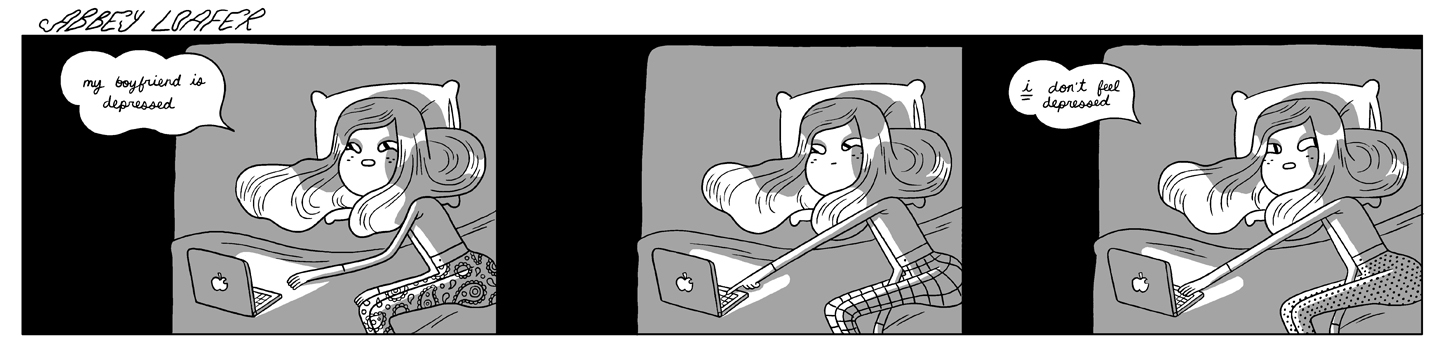
Michael DeForge has completed his 'Abby Loafer' strip for Mother News. You can read it all here. It’s the story of a fashion columnist and her day to day life. The twist though is that it’s by Michael DeForge which makes it intrinsically better than anything else being published right now.

Ryan Sands and 'Thickness' are spotlighted in The Pop Manifesto. Also, I read this interview between Ryan Sands and Frederik Schodt which originally appeared in 'Electric Ant' #1 that i really enjoyed. For context, Schodt was one of the key players in bringing Manga (and Tezuka in particular) to America.

Autopic could justify it's existence based on this Nancy gif for the next decade.

Simon Hanselmann is selling 'Truth Zone' originals (installments 1-69). You can browse them here.

New issue of Derek Ballard’s 'Cartoonshow'. This issue being #2.

Patrick Kyle’s Batman fan comic 'You Can Never Be Me' is online. I think this debuted at BCGF last year and is now out of print, so unless you own it this is probably the only chance you’ll have of reading it.

A new Kyle Baker strip emerged. Besides whatever Michael DeForge is doing, this is probably the best thing being published.

Wednesday, August 7, 2013

train kept a-rollin' 004: what if? avx #4


What If? AvX #4 (Marvel)
by Jimmy Palmiotti, Jorge Molina, Gerardo Sandoval, Norman Lee, Carlos Lobos Cuevas, Rachelle Rosenberg

'What If? AvX' is probably the most cohesive companion 'What If...?' story to ever come out. It presents a story that bears little resemblance to the events of 'Avengers vs. X-Men' yet stems entirely from the event in such a way as to reinforce one of the dominant messages of the event. Namely, Captain America is always right.

'What If? AvX' is the worst case scenario that the Avengers try to prevent in 'Avengers vs. X-Men' when they go to Utopia and ask Cyclops to hand over Hope so they can take her away from Earth as the Phoenix approaches. They fear that she is unprepared and that the Phoenix possessing her will result in the destruction of the planet. While the planet is not destroyed in the final issue of 'What If? AvX', the entire population of the world is killed*. Hope is made the host of the Phoenix, she is unable to control it, not mature enough to wield its awesome power, is corrupted, and helps set into motion a chain of events where Magneto is made the new host and, in his dying moments, kills everyone else in a final act of spite.

(* It doesn't fit into my piece here, but the ending of this story is the one place where ambiguity exists enough that it’s almost interesting. Wolverine kills Magneto while he’s the Phoenix and, as he dies, he explodes in blinding white light. Wolverine is saved by Jean Grey who has returned and they become the Adam and Eve of Earth as they look to rebuild humanity, hopefully better this time around. What’s not explicit is whether this is what happens or whether this is all in Wolverine’s head. Did only he die and this is the afterlife? We don’t know. I like that one more because of what it says about that character. It’s more personal and less cheesy if it’s all in his head or stems from his desires. If it’s what really happened, then it’s pretty laughable.)

'What If...?' stories providing “worst case” scenarios is not a new concept. However, rarely (if ever) have they existed almost for the sole purpose of justifying the morality of characters that, honestly, wound up looking like the bad guys by the end of the story. No matter how many times characters throw the death of Xavier in Cyclops’s face, it doesn't change that he was right and that Captain America made a bad situation worse by refusing to trust in his friends. In 'Avengers vs. X-Men', Cyclops went from a crazy cult leader to the man who brought about the salvation of his race, all the while being vilified by a man who thought it best to continue trying to hit beings with the power of a god instead of working with them as they used their powers to make the world a measurably better place. So, here, we have the evidence: had Hope gotten the Phoenix immediately, the world was fucked.

Captain America was right.

Captain America was right.

Captain America was right.

This was an idea that I kept circling when writing about 'Avengers vs. X-Men'. “Captain America was right.” It wasn't my contention, of course. I always said “Cyclops was right.” But, what I wanted to say was “Captain America was wrong.” Fuck who was right just so long as that character was wrong. Part of it is my natural chaffing against unimpeachable authority figures who have authority because they have authority because they have authority, a trait that always seemed to sum up Captain America to a large degree. He’s right because he’s right because he’s right. It’s one of the laws of the Marvel Universe. It’s lazy bullshit. It allows for simplistic writing that ignores the reality it’s creating simply by saying it isn't true. Why was Cyclops a villain? Because Captain America was in opposition to him. No wonder people thought I was stupid for reading all of those comics...

There’s something both rewarding and incredibly grating about reading a four-issue alternate reality story that seems to exist to justify the original story’s core message. Four issues that could basically be a briefing by Captain America to the president on what he believes will happen should the Phoenix be allowed to possess Hope. As I said before, it fits nicely into 'Avengers vs. X-Men' in a thematic, conceptual way. It will sit there as a quick reminder that, while Cyclops seemed like he knew what he was talking about, Captain America was really right to intervene and delay Hope’s encounter with the Phoenix, so there. It supports the original story in a surprising and completely unsubtle way. It also feels cheap. This was the implied depiction of events should the Avengers fail. Why in the world did it need to be given four issues? This story already existed within 'Avengers vs. X-Men' and just needed a reader with a slight imagination to bring it forth. What happened to 'What If...?' stories that actually challenged readers and delivered something far outside their expectations? Because this wasn't that. This wasn't Spider-Man can’t shake the Symbiote loose, so it uses him all up and winds up possessing Thor and the Hulk until Black Bolt kills it, ending with Peter Parker as an old broken man (I really liked that one). This wasn't even the by rote Wolverine is the king of the vampires or “What if the Age of Apocalypse had not ended?” (turns out, it didn't...). It was “Here’s the story that was heavily implied, so give me 16 bucks, asshole.”

I always come back to that story in 'What If? Civil War' where Captain America and Iron Man stop fighting, talk things out, find a compromise that works for everyone, and the story ends with them overseeing the superhuman community together, happy that they made it okay. Civil War was one long “Captain America is right” story (where he had an actual point, I’ll admit) and that story was a big “fuck you” to the original story, undercutting its central premise, while pointing out that both sides were wrong. I don’t know why, but I really like that. I guess I’d rather read a story that tells me the official version was crap than it was for the best. It seems less like hype and advertising that way. 'What If? AvX' is an ad for why 'Avengers vs. X-Men' was better than you thought and it makes you pay for the privilege of reading it.

Captain America was right.

I’m a fucking idiot.

And the gravy train keeps a-rollin’ on and on... 

Wednesday, July 31, 2013

train kept a-rollin' 003: what if? avx #3

by Chad Nevett


What If? AvX #3 (Marvel)
by Jimmy Palmiotti, Gerardo Sandoval, Jordi Tarragona, Rachelle Rosenberg

The creator names on the cover of 'What If? AvX' #3 are incorrect. They’re a carryover from the second issue where Jorge Molina penciled the issue, Norman Lee and Rick Magyar inked it, and Rachelle Rosenberg colored it. The third issue still lists those four names under Jimmy Palmiotti on the cover, but the art team is actually Gerardo Sandoval handling the penciling and some inking, Jordi Tarragona doing the rest of the inks, and Rachelle Rosenberg coloring (and acting as the only artistic link to the first two issues). It’s the same sort of... well, I don’t want to call it laziness, because that brings some horrible connotations, but, maybe, incompetence? It’s the same sort of incompetence that also leads to three dead characters (see last column) showing up as part of the cast on the recap page. Is this comic maybe a low priority? Again, see last column. Editorial blunders, while amusing, are not what I want to discuss.

The change in pencillers with this issue is appropriate. Normally, I’m with everyone else and hate to see the art shift mid-project (unless purposefully designed that way or the new artist being a vast improvement over the original) and my reason for not thinking that this time is one of those instances where I imagine people will understand my reasoning while still thinking that my approach is a little askew. 'Avengers vs. X-Men' was not an artistically cohesive event. Few are once you factor in tie-ins, but 'Avengers vs. X-Men' featured three pencillers through its 12-issue run (John Romita, Jr., Olivier Coipel, and Adam Kubert) with another penciller (Frank Cho) drawing issue 0. Basically, the first half of the event was done by Romita with Coipel and Kubert switching off on the second half. The result is a nice looking series that has zero visual or artistic cohesion, and it works to a degree because the series was also written by five writers. It was a hodgepodge mess of large-scale collaboration where consistency and unity were not invited. So, it’s only appropriate that 'What If? AvX' should shift artist teams in its third issue (if only they had numerous writers as well...), offering no sense of cohesion and visual consistency.

Because, obviously, Gerardo Sandoval’s art looks very little like that of Jorge Molina. Molina’s art is clean and blocky, aimed mostly at clarity and communicating exactly what is happening. There’s a little bit of roughness that creeps in around the edges that hints at something more stylistically interesting and makes me a little sad, because I would have loved to see more of that style. The way that he draws Magneto and Hope sparring in the first issue hints at something a little more lean, a little darker and messier that sits in contrast to the more open, clean-lined work he does elsewhere. His page layouts do not adhere to a set grid structure, but he rarely breaks from direct square or rectangular panels, again in the service of clarity and ease of reading. Panels are usually structured along three- or four-panel tiers with a somewhat steady pace that slows and speeds up depending on the moment. The rare moments where he breaks from these conventions are cases of ‘big’ moments where a double-page spread is required or, late in issue two, where Thor flies at the Phoenix and Molina uses a two-page layout, giving three-quarters of the room to that shot with two panels (one at the bottom of each page) that closes in and showcases Thor and the Phoenix. The first issue was looser with this, having more instances of characters breaking the panel borders, possibly because of the deadline crunch of the second issue. The second issue offers only one real moment of formalist play early on where the Black Panther is in a spaceship, communicating with Captain America. It’s a fifth-tier panel at the bottom of the page on a page where every tier is a single panel taking up the entire length of the page. The Black Panther’s back is three-quarters to us and we can see the ship’s screen in front of us along with his teammates in space and the Phoenix. The panel has an inset, though: a circular shot of the Panther’s head that is drawn like a word balloon coming from the other Panther figure. It’s not anything remarkable, but does show a willingness or ability to break from the layouts that we see in the first issues of 'What If? AvX'. Stylistically and structurally, his art is aimed at clarity and directness. It’s very difficult to be confused or thrown by anything Molina presents in the first two issues.

Gerardo Sandoval follows that example to a degree, but seems far less interested in clarity and ease of reading. His page is an awkward layout of the Vision, Ms. Marvel, and Nova descending upon Magneto, Emma Frost, and the Phoenix-possessed Hope on the Moon. The perspective is from above the three mutants, albeit from an angle, with the three Avengers at the top of the panel, in front of the reader, almost like our perspective is meant to be as some non-existent fourth Avenger descending onto the Moon. It’s clunky in the way that characters are positioned on the page and looks somewhat cluttered. Stylistically, Sandoval’s art is not something I particularly like. There’s a manga influence in it that results in lots of hair spikes and youthful faces. A horrible artistic crime, I know; it’s simply not something that I find visually appealing. The characters look like less than what they usually are, if that makes sense. Magneto is a youthful, attractive man until he becomes ‘more evil,’ and, suddenly, gains scars and a face that shows his age to a larger degree. There’s very little naturalism or realism, but also not a strong enough dynamism to warrant the contorted poses meant to convey movement and action. Too bland to be weird, too weird to be bland. As it were. He has a tough time balancing the demands of the art and the demands of the writing in places. One page, where Iron Man pulls Wolverine from the ocean and they regroup with the Avengers is a cluttered mess of character shoved into whatever space is available given the number of panels and tonnage of word balloons. Then again, maybe the page didn't need such a large shot of Wolverine vomiting sea water? (A sentence I never thought that I would write...)

Despite my clear dislike of Sandoval’s work, there is that connection to 'Avengers vs. X-Men'’s artistic changes that allows me to move past it, intellectually. Even the choice of starting with John Romita Jr. then shifting to Olivier Coipel and Adam Kubert seems to be the pattern here. Romita, while more distinctive stylistically than Molina, is an artist that places a premium on clarity, while Coipel and Kubert are more willing to sacrifice clarity for style. That shift is reflected in 'What If? AvX', just not to the same degree. It’s a faint shadow of the original, like a lot of 'What If...?' stories of the modern Marvel.

The one area where there is almost parity is in the reproduction of one cohesive element in 'Avengers vs. X-Men'’s art: the coloring. The entire event (save the 0 issue) was colored by Laura Martin and, in 'What If? AvX', Rachelle Rosenberg has colored all three issues (and I assume will color the fourth issue). At first, when looking at issue three, I had thought that Rosenberg had taken a different approach to coloring Sandoval’s pencils from what she had done for Molina’s, but, looking at some side-by-side comparisons, it’s not as strong a difference as I had thought. It’s a little surprising to learn that, to a degree, how I view the pencil art influences how I perceive the color art. If I don’t like the pencil art, I seem to think that the coloring is weaker somehow. That is an effect that I hadn't given much thought before. Rosenberg’s coloring seems best suited to Molina’s pencils, honestly. She, like Molina, seems to be going for a clean, easy to comprehend style. She doesn't overpower the art with a lot of effects, but does help with mood and storytelling. I particularly like the way she depicts the confrontation in issue two as happening at dusk, something that the pencil art doesn't seem to call for, but adds an emotional tone to the scenes of destruction and death that wouldn't be there if she colored the scene as taking place in the middle of a sunny day. It also allows for a clear passage of time over the course of the series: Magneto and Hope spar during the day; the confrontation with the Avengers happens as dusk begins; the Avengers regroup as we shift to night; Magneto and Phoenix Hope arrive once night has fallen, leading, most likely, to a final issue that takes place at night. She provides a sense of time that tells us when events are happening that another colorist wouldn't necessarily include. I like that.

Next issue, I imagine Jorge Molina will return, but I almost hope that we get another new penciller to finish things. A Kubert to Sandoval’s Coipel after Molina was Romita with Rosenberg acting as the series’ Martin. It will be almost like a true alternate version of 'Avengers vs. X-Men' then.

Tuesday, July 23, 2013

train kept a-rollin' 002: what if? avx #2


What If? AvX #2 (Marvel)
by Jimmy Palmiotti, Jorge Molina, Norman Lee, Rick Magyar, Rachelle Rosenberg

So utterly dull and uneventful a comic was 'What If? AvX' #2 that the only way to amuse myself at this point is to imagine the parallel universe that goes along with this comic where this is the actual 'Avengers vs. X-Men' event done on fast forward and we have just hit the follow-up issue to Wolverine killing Storm where Magneto, by blowing up the Avengers’ big aircraft, kills Falcon and Colleen Wing. Can you imagine? A Marvel event where the first three deaths are a black woman, a black man, and an Asian woman... and all are there for the sole purpose of shock value? Hoo boy... I would not want to be alternate reality Jimmy Palmiotti.

Thankfully, for the Jimmy Palmiotti that actually exists, this is Real World 616 and no one gives a fuck. But, should they? After all, what is the difference between the senseless deaths of these characters here and in the real 'Avengers vs. X-Men' besides some concept that one story “counts” and the other doesn't? These are all fictional constructs that live and die on a writer’s whim (or editor’s or editorial team’s or... you get the idea). Hell, they’re the same characters, really, with only a somewhat absurd conceptual caveat dividing the outraged from the apathetic (or unknowing). If those characters get killed in the exact same fashion in 'Avengers vs. X-Men' #1 and 2, then people lose their minds, but, they get killed in 'What If? AvX' #1 and 2 and nothing? I both understand and don’t understand, if that makes sense. And it seems a little strange that I actually understand this to a degree.

Really, I’m not trying to criticize the online writers who usually write about deaths like these, they simply present a convenient example in the dynamics of superhero comic readers on a larger scale. Last year, 'Avengers vs. X-Men' #1 was the biggest selling comic of the year to that point and, this year, how many people even know 'What If? AvX' is coming out at all? Part of that is down to hype and marketing. Part of that is the lack of big name creators. But, mostly, it’s that 'What If? AvX' “doesn't count,” so people are inclined to skip it. Having read the first two issues, that seems like the safe bet to keep eight bucks in your pocket, except the decision of those readers to not care was not made after seeing the issues released so far. It wasn't even made when the project was first announced. It was made long ago when they decided to not care at all about 'What If...?' and other comics like it. There’s one group that “counts” and another that doesn't, and the latter isn't limited to extra imaginary stories like 'What If...?', it’s any comics that don’t drive forward the main thrust of the shared universe it inhabits. Quality has nothing to do with it. Content only does in the most superficial sense. And none of this is news to any of you...

So, why does 'What If? AvX' exist? Why is the gravy train still a-rollin’ one year later? The AvX brand is barely remembered, the creative team is C-list at best, and the total cost of this futile exercise is $16 when few would probably shell out one quarter of the cost for a more compact version of the exact same story... No one cares.

They should, though. Because there is no difference between Storm, the Falcon, and Colleen Wing dying as they did here or in any other comic. There isn't. It’s still a comic where those deaths happened in a meaningless manner meant to rack up a tiny body count and create the illusion that the stakes are high all of a sudden. Who cares if it “counts?” These are fictional characters where any story can suddenly “count” or be forgotten and cut out of the history books, by the publisher, by a writer, by an editor, or by the fans. There’s no such thing as “counts.” Go to my old blog and take a look at my 'Avengers vs. X-Men' Reader Order where I put the entire event into a logical, readable order, and scroll right to the bottom where the last two entries are: 'A-Babies vs. X-Babies' and 'What If? AvX'. If they’re part of the reading order, they count. For me, at least. To skip anything on that list is to skip part of the entire 'Avengers vs. X-Men' story. It’s not like there weren't massive, glaring contradictions before having to reconcile the original event with its alternate reality version. Who cares? Is it so hard to hold contradictions in your head, see them there, recognize them, and, yet, not have any invalidated? If 'What If? AvX' was a better story than 'Avengers vs. X-Men', would I seem strange if I preferred to think of it as the “real” story that “counts?” I have said many, many times that I absolutely love the second story in that 'What If? Civil War' one-shot that Marvel published where Tony and Steve talk things out and no one dies. That feels more like the characters that I have read all my life than the actual Marvel event. It feels more “real.” So, in my mind, it is.

Except when it isn't, because it doesn't count.

Fuck.

Wednesday, July 10, 2013

train kept a-rollin' 001 - what if? avx #1

by Chad Nevett


What If? AvX #1 (Marvel)
by Jimmy Palmiotti, Jorge Molina, Norman Lee, Rachelle Rosenberg

I didn't already know all of this. The biggest Marvel press promotion ever with the biggest event of last year and what did they deliver? A comic that reworks some of the things that the massive amount of comics released last year showed us. I'm almost at a loss over what I can possibly say about this comic. The Phoenix is coming, the Avengers think it's coming for Hope, they want to stop that, Magneto has gone all crazy Mutant zealot, and... fight! But, seriously, I knew most of that going in. That's basically the same premise. The first issue tells me the premise. Again. In a slightly altered form. And guess what? It's not significantly better that way. It's not such a vast improvement over 'Avengers vs. X-Men'.

It's not even that 'What If? AvX' #1 is a bad comic. It’s not a good 'What If...?' comic for one thing. It lacks that central bit of information that drove almost all issues of 'What If...?' throughout its various incarnations: a simple question and answer. “What if Spider-Man joined the Fantastic Four?” “What if Captain America was never unfrozen?” “What if Wolverine was king of the vampires?” “What if Captain America and Iron Man learned to just fucking talk to one another instead of hitting?” I don’t know what the question here is. “What if Avengers vs. X-Men happened differently for no good reason?” There’s no clear point of diversion from what happened in 'Avengers vs. X-Men' #1 last year. There are differences, sure, but that’s just rewriting. 'What If...?' was also rewriting, sure, but in a specific way, with a specific point and a clear purpose. This... this is change for the sake of change. That is not necessarily a bad thing.

I don’t particularly care for this issue. I guess the name 'What If...?' raises certain expectations and this does not meet them. I’m not sure what this actually is. In the same way that DC’s Elseworlds line of books was different from Marvel’s 'What If...?', this issue seems like a third thing, one that we’re used to: the remix. Warren Ellis called his work on Marvel’s Ultimate line of books a remix. Taking a story you already know and changing it around for the purpose of doing something quasi-new. Except, instead of having the distance that the Ultimate books have or even the distance that Brian Michael Bendis writing a new story about Ultron has from previous Ultron stories, this is another version of 'Avengers vs. X-Men' #1 except with random changes that don’t seem any more or less logical. The only function they seem to have is pointing out how artificial and random these stories are.

Why were the “Space Avengers” in 'Avengers vs. X-Men' those specific characters? Because someone decided that those characters should be the ones sent into space. Here, Jimmy Palmiotti decides to send a different roster into space to confront the Phoenix. Why? Because. Why was Cyclops sparring with Hope in 'Avengers vs. X-Men' #1? Because that’s what Brian Michael Bendis wrote. Why is Magneto sparring with Hope in 'What If? AvX '#1? Because that’s what Jimmy Palmiotti wrote. Why does the Phoenix kill the Guardians of the Galaxy? Why does Magneto confront Captain America when he comes for Hope? Why...?

Because.

Because this isn't really 'What If? AvX' #1. Oh no. It’s 'Avengers vs. X-Men' within the world of “What if Magneto was the leader of Utopia?” It’s only hinted at, only suggested, but it’s clear that what’s missing is a previous story where Magneto led the Mutant race coming out of 'House of M', not Cyclops. Where Magneto spearheaded their move to independence on Utopia in response to Trask and Osborn. Where Magneto leads the Extinction Team. He is the face of mutant-kind, the teacher of Hope, and the man that says no to Captain America when he comes to take his people’s messiah. If you thought Cyclops was a crazy motherfucker...

Within that context, this issue begins to make sense, except for one thing: why in the world would Captain America go to Utopia to reason with Magneto? (I know, I know: because that’s what Jimmy Palmiotti wrote! Aw... fuck you.) That’s the moment that does not totally ring true. If anything, Magneto leading the X-Men seems like it would mean a swifter move to violence. A calculated strike on Utopia with a shoot first, ask questions later. A comic where the Avengers are the crazy zealots of a cause to save the planet. That would have been a nice inversion, don’t you think?

(But, look at me, talking about what the comic is not, what the comic is. Gotta work the rust off somehow, I suppose.)

Right now, 'What If? AvX' #1 is a simple alternate to 'Avengers vs. X-Men' #1 where Black Panther goes into space, the Guardians of the Galaxy get blown up, and Wolverine stabs Storm accidentally. That is to say: it’s not that much different from a comic I read last year.

“Buy the ticket, take the ride.”

Tuesday, January 1, 2013

direct message 007: the amazing spider-man #700

by Alec Berry and Chad Nevett

It’s an anniversary edition of Direct Message. We hit our 7th column right when Amazing Spider-man hits its 700th issue. Get it?

sigh …

Alec Berry: So, Chad, this comic book ushered in death threats and another round of USA Today articles. It’s “controversial,” scandalous even. How do we respond?

We have our individual takes on the major idea at work here as well as the coming status quo, but for now let’s discuss The Amazing Spider-man #700 as a comic book and judge it as so.

I get it, Internet. Dan Slott “knows” Peter Parker. He understands him. He’s faithful to the core. That’s great, but Dan Slott didn’t write a good comic book here, and Edgar Delgado didn’t color one, either. Instead, what’s here is cheap and sloppy. Not horrible, but neither is there anything special about the execution or the attitude. Instead, it’s another issue - not the FINAL issue.

I know, I know … it’s not really the final issue, and it’d be simply ignorant of me to expect anything other than a sales grab from a comic book of this ilk, but could I not at least expect it to be well produced? Probably not, because that isn’t the point, right? The point is that final page catapulting readers to the next thing; it’s about a plot point; it’s about an illusion of change. Which, really, has been Slott’s run all along.

My main problem with the issue is that it flounders those key moments (like the actual death or the rescue of the cast). They feel cheap, in most instances, because there’s either not a whole lot put behind them or they come a little expected and on cue. The kiss really holds this tone because it’s sooooo transparent and on beat. Slott tries to earn it by dredging up the history of that relationship, but really he makes it all the more typical by doing so. As a reader, it’s pretty understood where those characters stand. The kiss isn’t a necessary action. Granted, it’s not really Peter under that mask, but even then it feels forced (which is creepy in its own way).

The Jonah father/son scene reads like a TV-movie-of-the-week moment: tacky as fuck.

And, honestly, actually putting Peter in heaven comes off as lazy, like it’s playing for that easy applause. Is that necessary? Smarter storytelling could have suggested the character’s fate and Uncle Ben’s approval without going there.

I don’t know how else to say it, but The Amazing Spider-man #700 just exemplifies the adjective “cheap,” even without the big upheaval. The story’s colorist, Edgar Delgado, really pushes that for me. His style  resembles the sugary gloss of fruit-flavored candy, amplifying the Subway-advertisement tone of this whole thing. It’s bright and too smooth. A product lacking heart.

And that’s what all this should have been about: the heart. This should be a celebration of something, but really the issue is in a rush, trying to leave before midnight rather than tearing on, abusing the mini bar and reveling in the party until dawn. This issue’s just another beat. A beat we both paid $8 for.

We’re smarter than this. I’m not shocked by what I got, maybe not even disappointed. I’m just surprised the industry feels it can still get by on these death stunts and hallmark issue numbers. That’s been the trend for a few years now, and it’s clear that at least the critics and online-centric readers see past this. But we all still buy, don’t we? Shelling out money for bullshit we know we’re paying for. God forbid we feel left out.  

Chad, express your general reaction. You’re on board for Superior Spider-man. Tell me why.

Chad Nevett: Easy: I like the idea. At least enough to give it an issue of this ‘new’ Spider-Man to see if it looks like it will have legs.

But, getting back to issue 700... it didn’t really do much for me as a comic either. There seemed to be some inconsistency in how Octavius in Peter’s body acts. In issue 698, he never did anything evil. He seemed rather excited about not being burdened by his old life and exploring the potential of what he can do as Peter Parker. Obviously, Peter would assume him to be evil, but there was no indication of that. After all, why mess up a good life because you took a bad turn in your previous one? And that seemed to run through the following issues except when it was convenient for Octavius to play a heel a bit more. That uncertainty of who this character is and what he wants bothers me. It didn’t seem like he needed those memory breakthroughs to not be bad, because the thing about Dr. Octopus is that he wasn’t always fully evil. He was the dark side of Spider-Man in that things happened and choices were made that put him down a bad path. He wasn’t necessarily bad, he was in a context that made him act that way more often than not. That’s a big difference from other bad guys. As we saw in 698, he seemed ready from the get go to continue with Spider-Man as a hero -- he merely wanted to live Peter Parker’s life to the fullest and, part of that, was being the best Spider-Man he could be.

The heaven scene was tacky as hell. The art on the whole didn’t impress me. I don’t find Humberto Ramos to be the best fit for Slott’s writing nor this character and his world. I’ve always seen Spider-Man being rooted a bit more in reality visually.

I do love the idea. I loved the idea of issue 698 where Octavius demonstrates that Peter Parker’s life as Spider-Man doesn’t have to be one of misery. To a degree, he brings a lot of his pain and suffering on himself. All of the tools are there to be a wonderfully happy and content person, and Octavius sees that. It’s a great criticism of Peter Parker, of his flaws -- and, through, Octavius, introduce new flaws. In the Ultimate Universe, they went with another kid as Spider-Man. Someone even younger and more inexperienced. I like that, here, we have the opposite. It’s still the body of Spider-Man, but with another brilliant man with experience in superhuman matters who will bring a new perspective to what being both Peter Parker and Spider-Man means. There’s a lot of potential in that idea. I’m not sure Dan Slott is the writer I want to see try to realise that potential, but I’ll give him a shot since it’s him or no one.

Did you also get Avenging Spider-Man #15.1? I found it to be a better introduction/teaser for this new Spider-Man concept and it sold me on trying Superior Spider-Man #1 more than Amazing #700 did.

AB: I didn’t. I was unaware.

I agree with you. The idea itself intrigues me and makes sense. Ock and Peter are very similar and have always been opposite sides of the same coin, so the symmetry between the characters really kills any argument of this direction not making sense.

The notion of pushing the character forward - making him a superior super hero - also intrigues me. Granted, fucking up is sort of the soul, but Spider-man stories could benefit and flex under the premise of having the character at the top of his game. That pushes a writer to break the usual formula behind a Spider-man comic, and the expected cliches fall away. Will that happen? Possibly, but I suspect the arc of this tale is that Ock, now possessing Peter’s memories, will fail to commit superior actions under the old Parker trope of “guilt.” Plus, he makes a promise to protect Peter’s family and friends, which has always been the crux of the character’s seemingly sub-par performance. He’s too responsible, unable to truly meet a potential.

The illusion of change, but under it the same, old story. That’s Dan Slott’s success.

Do you like the choice of killing Peter? I don’t exactly care, but it seems a more entertaining story exists with keeping Peter alive in Ock’s body, having him live that experience while the characters really switch roles. Maybe that reveals something about each character we didn’t know before. There would also be room to play with structure and voice, I think. I don’t know, just an idea.

Also, how did you feel about Ock’s push to bed MJ? That seemed out of place, and as a writer I wouldn’t place my attention there. Not that, under the right execution, that couldn’t be interesting. The focus just felt wrong for this tale, like a side-tracked thought. The character’s racing against the clock, it seems, trying to ensure that the other character is dead, but Slott must stop and jarringly jam in a few creepy sexual scenes. Obviously, yeah, MJ must be covered at some point, but why not hold that off for later? As a writer, you know Ock’s keeping that body, so save yourself a story.

Also, MJ’s short-shifted to basically being a supportive wife. Where’s that spunk?    

CN: I think it’s hard to avoid, mostly because Octavius spent his life as this overweight, nerdy outcast and, as I think you know, something that often fuels genius is that sense of rejection from the opposite sex. Now, here, he’s put in the body of a man who was intimately involved with a model, an actress, an object of men’s desires... for him to ignore that would ring hollow. I think there’s room in that part of the story to see his growth as he struggles to move past simply satisfying all of his base urges and becoming a genuinely good, heroic person. Then again, I tend to view very little as off limits, even in Spider-Man comics. If they were to simply gloss over the conflict at play here, it would be terrible, dreadful writing. But, if they were to explore the implications of what it means to be in possession of another person’s body, how you can violate others in unspeakable ways without their knowledge... It’s another angle on “With great power comes great responsibility.” Otto Octavius has gained the power of people thinking he is Peter Parker and Spider-Man, so what will he do with the responsibility that comes with that power? That seems to be the central question of Superior Spider-Man. Or, if it’s not, it should be.

I don’t mind ‘killing’ Peter, because it was accomplished in a way where it is incredibly easy to bring him back. Octavius has overwritten his mind, but it’s not hard to present comic book science where the body fights back and Peter’s consciousness slowly comes back until, finally, Peter Parker is Peter Parker. It’s a story with an obvious exit strategy -- and I like that. If only because there’s also the potential for a period where Spider-Man is basically Firestorm, Peter and Otto both rattling around inside that head, trying to work together (and against one another at times). Isn’t that fantastic? Spider-Man ripping off a Spider-Man rip-off?

AB: Well, the story rips-off “Kraven’s Last Hunt” without any of the craft. It even includes this moment: 


“Kraven’s Last Hunt” offered a complete picture, a change in pace, tone and structure and an effort to push those characters until they arrived somewhere new. Even when Spider-man was “killed,” the gimmick was turned into something worthwhile.

Slott’s isn’t that kind of comics creator, though. He’s a writer who writes for the thrill of hitting those cool moments (which is fine), yet he ignores the form almost entirely. That’s why he’s such a success on Spider-man because that’s what the audience wants (and why he drives me up a wall).

I don’t know. That’s really all I can say about this comic. It wasn’t absolutely terrible, and the idea is fine enough and may provide a few sparks. It just feels cheap and represents the wrong of comics.

Plus, those colors are so bright and polished that they’re dull and forgettable.

CN: So... no Superior Spider-Man Direct Message, then?

AB: ‘Fraid not.

Somewhere, Dan Slott gives his order. A message board will soon be soaked in blood. For now, sweat and saliva stew, lubricating the crevices between his keyboard keys.