Showing posts with label jackson guice. Show all posts

Friday, December 27, 2013

1987 and all that 020: x-mental

by Matt Derman

...reading comics from the year i was born!

Uncanny X-Men #213-224 (Marvel)
by Chris Claremont, Alan Davis, Barry Windsor-Smith, Jackson Guice, Marc Silvestri, Bob Wiacek, Dan Green, Glynis Oliver, Tom Orzechowski, et al.

Something that comes up a lot in X-Men comics is the idea of a mutant community, whether or not it exists and, if so, what it’s like or should be like. In these issues from 1987 though, Chris Claremont is less interested in that idea of group identity as he is in exploring what happens when a single person’s identity is threatened, stolen, or lost. The team’s shared objectives and attitudes are relatively stable. The X-Men get attacked directly a lot in this period, and constantly being on the defensive makes it easier to work together toward a common goal: survival. Yet while as a unit they’re fairly reliable, several individual members of the team have some sort of identity crisis during this run, from emotional and mental breakdowns to having their minds controlled to the even worse fate of poor Madelyne Pryor (see below). It’s not a theme that is openly discussed or always present, but there are pretty regular reminders in these comics that one’s sense of self is a fragile thing, and that the results of damaging or removing it can be severe for the person affected and everyone around them.

Though other, smaller problems pop up along the way, the X-Men’s primary opponents in these issues are the Marauders, a gang of evil mutants secretly working for Mr. Sinister. They go after not only the current X-Men, but their friends and former members as well, and the Marauders don’t limit themselves to strictly physical assaults. Their leader, Malice, is a bodiless psychic force that invisibly enters other people and takes control of them. At first, she uses this power to make several of the X-Men fight one another, but eventually Psylocke’s own psychic abilities combined with Storm’s willpower are able to temporarily defeat Malice. So instead of just body-jumping anymore, Malice sets up camp permanently in Polaris, who’s not even an active X-Man when this all goes down. But she’s still their friend, so having her become a foe but knowing she isn't in control of her own actions presents an especially difficult challenge for the heroes. Most of all Polaris’ boyfriend Havok, who pretty much falls to pieces when he sees that the woman he loves has been mentally hijacked by his enemies. Torn between his powerful affection for Polaris and his just-as-strong fury toward Malice, Havok breaks down.

Malice also does a number on Dazzler, the first person she inhabits and controls. Like Polaris, Dazzler isn't’t technically one of the X-Men at the time, trying instead to make a go at a music career. That dream is quickly cut short by Malice, even after she’s been driven out of Dazzler’s body, because the whole affair forces Dazzler to rejoin the X-Men rather than staying out on her own as an unguarded target for future Marauder attacks. So Dazzler becomes a superhero again, even though it’s not the life she’d choose for herself, and though she does it well and with great determination, it takes it's toll on her. She’s on edge, constantly second-guessing herself and losing her temper at the drop of her hat, acting rashly and arrogantly for no reason. The lifestyle thrust upon her is not one that is necessarily a good fit for her or that she enjoys. There’s some satisfaction to be gotten from doing good, but it’s not nearly the same as what she gets from singing and performing and doing all the other things she truly loves. Yet fighting alongside the X-Men is better than dying alone, so she sticks it out despite her unhappiness and emotional instability.

Both Havok and Dazzler see the lives they were trying to build suddenly and unexpectedly demolished, one personal and the other professional. They have to start from zero, trying to find meaning in the incessant violence and fear of life with the X-Men. Along similar but even more dramatic lines, Madelyne Pryor, not even a mutant but married to one, is put through absolute hell by the Marauders, only to end up, like Dazzler, with no options except to stay with the X-Men indefinitely for her own protection. After putting her in the hospital and stealing her baby, the Marauders go further and erase every trace of Madelyne’s life, making it so that, according to any and all available records, she never existed. With no way to prove who she is, and no real leads as to the whereabouts of her stolen child or her M.I.A. husband Cyclops, Madelyne’s situation is dire to say the least. She knows who she is, and so do the X-Men, but the rest of the world refuses to acknowledge it, making her a strange sort of non-entity. Powerless to change what has happened to her or to do anything that would significantly improve her future, Madelyne’s stuck, still alive but without a life. It’s torturous and hopeless and huge, driving her, quite understandably, to the point of nearly committing suicide.

Even Wolverine, the super-experienced, cool-as-a-cucumber veteran of the team, loses himself for a time. While investigating the scene of one of the Marauders’ many crimes, he picks up Jean Grey’s scent, the woman he loved unrequitedly for years before she died (it’s really Madelyne he smells, because she’s a clone of Jean, but nobody is aware of that yet). With all his painful memories of Jean flooding back to him all at once and out of nowhere, Wolverine is overwhelmed and freaks out completely, becoming the most animalistic version of himself, a being of pure instinct. It doesn't last for more than a few days before he snaps out of it, but Wolverine is the only X-Man to have this kind of breakdown due to his own senses betraying him, as opposed to the machinations of the story’s villains. Yes, the Maraduers are indirectly involved, since it is in searching for them that Wolverine goes nuts, but they don’t do it to him on purpose. It is his own already fragile and fractured psyche that shatters his self-control.

Not everyone in this book has their identity upturned like this. Both Longshot and Psylocke manage to avoid the kinds of personal crises their teammates have to deal with, for very different but equally logical reasons. Longshot is by nature a bit unpredictable, the token wildcard of the team. This is not to say he doesn't have a personality, but as an outsider in our world, he has a naiveté and curiosity that leave him on slightly less sure footing than the rest of the cast to begin with. Add to that his own ignorance of the exact workings of his luck-based superpowers and corresponding lack of control over them, and it becomes clear why messing with Longshot’s sense of self would be trickier and maybe less interesting than it is with everyone else. He’s already trying to figure out who he is and his place in this world, so there’s no need to introduce those dilemmas again.

As for Psylocke, she keeps her wits about her by virtue of being the X-Men’s resident telepath. She is their most useful defense against Malice, their communication system, and the most stable mind among them. It’s hard to be effective with psychic superpowers if you don’t have a good connection with your own mind, and Psylocke is nothing if not effective. The first issue of this run, 'Uncanny X-Men' #213, is all about Psylocke proving her worth by facing Sabretooth one-on-one and living to tell the tale. After that, she’s firmly cemented as the team’s sturdiest pillar, and it’s a role that suits her. She’s considerate, intelligent, self-reliant, and able to tap into the thoughts and insecurities of all her allies and, if needed, soothe them or bring them back down to Earth. With the other X-Men losing their grips to one degree or another, it’s important that the team have a rock, and Psylocke’s the perfect person to fill that slot.

The only X-Man I haven’t addressed—other than the handful of members who are comatose for all of these issues thanks to severe beatings from the Marauders—is Rogue. She also manages to avoid any serious loss of ego or sanity, but Rogue’s whole power set is based on her draining the abilities and personalities of others and absorbing them into herself. She’s a walking identity crisis even when she has her act together, because she’s always got the powers and psyche she permanently took from Ms. Marvel rattling around in her head in addition to her own. That’s never exacerbated by the events of this run, but it’s not assuaged at all either, so she fits in with the theme of the fragility of identity through the very concept of her character.

There are several sprawling, near-fatal fights between the X-Men and the Marauders, all of them scripted, choreographed, and drawn quite nicely. Both sides take some heavy beatings and have a few close calls over the course of the long-running conflict. But the more significant threat to the titular heroes is the vulnerability of their personal identities, the fine line between sanity and madness, confidence and doubt, of which the Marauders are smart and sadistic enough to take advantage. It’s not the high-powered, theatrical superheroics that hold the most danger and intrigue in these comics. It is the resulting melodramas the characters are put through where the real excitement is found, impactful depictions of people who have lost track of themselves but have to move forward with their lives anyway.

Friday, December 13, 2013

1987 and all that 019: x-mettle

...reading comics from the year i was born!

Uncanny X-Men #213-224 (Marvel)
by Chris Claremont, Alan Davis, Barry Windsor-Smith, Jackson Guice, Marc Silvestri, Bob Wiacek, Dan Green, Glynis Oliver, Tom Orzechowski, et al.

Earlier this year, the X-Men celebrated their 50th anniversary, so now seemed an appropriate time to go back and revisit the 1987 issues of 'Uncanny X-Men' for this column. This post will actually be the first of two devoted to the title, since it’s a fairly dense book with a lot going on, thanks in large part to Chris Claremont still being the writer at that time. His style may not be to everyone’s taste, but you can’t deny that the man is a great storytelling multitasker, able to have numerous threads of every length and thickness running through his comics simultaneously without bogging things down. That’s as true as ever in his X-Men stories from ’87, because for all their complicated concurrent plots, these comics do a damn fine job of keeping the two most significant narratives on track and weighted evenly. Next time, I’ll look at the more action-packed of these two storylines: the team’s ongoing struggle against the Marauders. Right now, though, I want to talk about the more intimate, engaging, and unusual plotline of a depowered Storm proving to herself and the reader what a noble and bad-ass hero she is, even without being “super.”

When this particular run of issues begins, Storm has already been robbed of her mutant abilities. She’s used to being non-powered by now, though not necessarily at peace with it. She’s still an X-Man through and through, and is in fact the team’s leader at this point, she has to deal with superhero dramas all the time despite not technically being a superhero herself anymore. It’s a lifestyle she chooses to keep up instead of having it thrust upon her like most other mutants, and that’s an admirable choice that makes sense for her character, but it also makes regaining her powers an appealing notion no matter how good she is without them. When all of your problems are nails, it’s mighty helpful to have a hammer around.

The desire to have those incredible powers again is brought to the fore by the first small story arc in which Storm is the central player. After being accidentally knocked unconscious by an out-of-control Wolverine, Storm wakes up imprisoned in the none-too-secure dungeon of some strange hunting lodge in the middle of the woods. She soon meets her captors, three superpowered WWII veterans named Crimson Commando, Stonewall, and Super Sabre, who kidnap people they deem criminals in order to hunt them for sport. Mistaking Storm for an arsonist because they find her passed out in a burned building, the trio of murderers pair her up with a teenaged drug addict/dealer whose boyfriend they have already killed, and give the two women a slight head start out of a weird blend of fairness and sadism. Unlike their usual prey though, Storm is determined, intelligent, and fit enough to cover a lot more ground than her pursuers anticipate, which allows her to set some traps and ambush them instead of merely fleeing. She’s also experienced enough in combat to actually hold her own when the time comes, even though her opponents all have enhanced abilities. They’re used to killing scared, confused criminals; she’s more than familiar with handling supervillains. So all of her moves catch them off guard while nothing they do surprises her in the least.

Though it’s a struggle to fully defeat them, Storm is always a step or two ahead of Crimson Commando, Stonewall, and Super Sabre (who obnoxiously don’t have a team name here, but do join Mystique’s Freedom Force later in the series). She manages to stop them without needing to kill them as they planned to do to her, and even talks them into turning themselves in. This story demonstrates how little Storm really needs her powers, but also reminds us why she still wants them and how undeniably useful they would be if she could get them back. It would've taken a few seconds at best for her to demolish all three villains if she’d been able to control the weather. Or heck, she could have just flown away first thing, since none of them had any means of following her in the sky. As impressive as she is with nothing but her wits at her disposal, some part of her brain no doubt spent the entire conflict wishing she could just snowstorm the bad guys into submission. She even openly pines for her old powers a few times. So once she’s free and back with her team, Storm sets out almost immediately to find a way to retrieve her lost abilities, beginning by finding the man who took them from her, Forge.

Once her search for Forge begins, it becomes Storm’s entire life, a distinct and wholly separate solo adventure she embarks on while the rest of the X-Men do their own thing. And with the exception of Wolverine playing a small role at the start and end, the story I described above about the three superhuman people-hunters was an all-Storm story too. She’s such an interesting character, extremely forceful when needed but otherwise quite serene and composed, so giving her some time in a spotlight all her own is a smart and enjoyable move. And it’s necessary to split her off from the other X-Men for this Forge story, because it’s not really a superhero tale. It’s more fantasy than any other genre, and even simpler than that, it’s a classic overcoming-various-trials-on-the-path-to-a-noble-goal narrative. To tell it properly then, Storm had to be removed from her usual environment so she could be gradually transitioned into the appropriate setting for this story. In many ways, the Crimson Commando (and friends) arc was a small sampling of what would come in the Forge arc, at least insofar as they’re both stories about Storm taking on insane odds with only her inner and outer strength to help her. But the Forge plot is thicker, more emotionally and narratively complicated, and far more tragic in its conclusion.

Storm begins at Forge’s old base of operations, but finds it dilapidated and mostly abandoned. The only person there is Naze, an old shaman and Forge’s former mentor. He tells her two things, both of which completely derail her effort to get her superpowers back. First, Forge’s guilt over taking away those powers drove him insane. Second, that insanity subsequently led him down a path of darkness so that now, rather than being the perfect instrument to prevent the end of everything, he’s going to cause it. Forge was apparently meant to battle a great force of existence-erasing evil called the Adversary, but instead his madness has turned him into the Adversary. Because Naze has the knowledge and Storm has the skills, and because they’re both so close with Forge, they team up (after Naze pretty much forces Storm to work with him) and begin an arduous trip through the wilderness and their own minds to reach Forge and stop him from undoing the universe.

They’re attacked by all manner of monster, usually some sort of oversized and slightly warped/enhanced animals. There are also some unpredictable and insanely harsh weather patterns, an insult-to-injury type of obstacle considering the weather used to totally be Storm’s wheelhouse. The closer she and Naze get to Forge, the more huge and difficult their challenges become, but Storm consistently keeps herself together and comes out on top. She acts quickly and with confidence, because she’s never given a moment to rest and over-think things. Luckily, Storm is the perfect person to deal with these kinds of incessant, fast-moving threats, because she’s self-aware and self-assured enough to trust her instincts and survive. As she and Naze make their way to Forge, she learns to rely on these instincts, so that when they finally find him, she tears through the horde of demons that try to stop her in something like a berserker rage. She gives in wholly to that part of herself, because it’s the part that has gotten her this far.

And when she’s standing before Forge, she stabs him with the same decisive haste, only to learn in his dying moments that she’d been tricked by Naze from the beginning. Forge wasn’t the Adversary, but was in fact trying to defeat the Adversary as he was always supposed to do. Storm, in her attempt to save existence, made its destruction considerably more likely. With Forge dead in her arms, Storm throws herself and the man she loved (and then killed) off a cliff, and that’s where we leave them at the end of 1987.

Of course, both characters would be seen again soon and many times thereafter, but the moment of their deaths is still a heartbreaking one. Because in all the issues leading up to this final fatal confrontation, Storm is such a pillar of self-reliance and intelligence, the revelation that she’s been a dupe and a puppet all along is a tough pill to swallow. To his credit, Claremont hints pretty heavily at it in earlier chapters, but even then, there’s an expectation that she’ll grow wise to Naze’s deceptions in time to stop herself from doing what she does. To actually watch her lose, to see her manipulated successfully, is painful and powerful. As she discovers she was wrong about Forge, the reader discovers that even Storm can be bested and blindsided, despite her unflappable disposition and, usually, the talent to back it up.

Of course, the fact that it feels unnatural to see Storm so thoroughly defeated says a lot about how awesome she is most of the time, including everything she does during her journey to find Forge. Those efforts may have been in vain in the end, but that doesn’t change the fact that she was impressive as hell when it was all going down. Swap out supervillains for magical forest beasts, and she’s no less in her element. Remove the safety net of her powers and the other safety net of her team, and she can still take all comers. If only she’d been a little less willing to so quickly accept that Forge’s agony over what he’d done to her had made him insane. I can see why it’d be appealing to think she mattered so much to him, and because she still had some lingering anger over the loss of her powers and his role in it, the idea of causing him pain might also have held some allure. She allowed herself to buy into this lie, and she trusted Naze from her own past with him, and it led to her kill a man she loved before he could save the world. At least when she screwed up, though, she kicked ass along the way.

Storm’s story is about the value of independence, indeed I’d call that the core of her character, but it also exposes some of the dangers of working alone. Maybe another set of eyes, belonging to someone not quite so close to the situation, could’ve seen Naze for the liar he was. Yet Storm’s lone wolf approach is what makes this narrative possible, because it needs to be a one-against-all kind of story. Her many victories are entirely hers, establishing her as one of the most capable X-Men around. But the enormous failure at the end is all hers, too, providing the gut-punch finale to her personal arc.

Friday, November 29, 2013

1987 and all that 018: a villain who defeats himself

by Matt Derman

...reading comics from the year i was born!

The Flash #5-6 (DC)
by Mike Baron, Jackson Guice, Jack Torrance, Larry Mahlstedt, Shelley Eiber, Steve Haynie

I’m not a real big Flash guy, but I’ve got nothing against the character either. I respect him from a distance, appreciative of what he can do and stand for as a superhero, but not especially drawn to him for any reason. As a result, my experience with Flash comic books is limited at best, and there are, I’m sure, many classic stories I’ve missed out on over the years. How, exactly, this seemingly minor two-issue arc from 1987 stacks up against the greater Flash library is impossible for me to say, but taken on its own, it’s a visually bold, conceptually compelling, and structurally unstable read.

At the time, Wally West was new in the role of the Flash. He’d been Kid Flash for years until his predecessor, Barry Allen, died at the end of 'Crisis on Infinite Earths' and Wally got to drop the “Kid” from his name. Whatever his moniker, though, he was still very much a kid, only twenty years old and also newly rich. Early in his days as the main Flash, Wally won the lottery, so suddenly he’s an A-list superhero and millionaire before he’s old enough to drink. His youth and relative inexperience are evident throughout this story, in which he half-bumbles through a few failed attempts to stop the villain before the villain accidentally stops himself. It’s not perfectly clear how much of Wally’s ineptitude was intentional on the part of writer Mike Baron, and how much of it is just a side effect from the script’s poor pacing. Whatever the case, Wally’s not too impressive a hero or even a man here, but lucky for him, he doesn't need to be in order to win in the end.

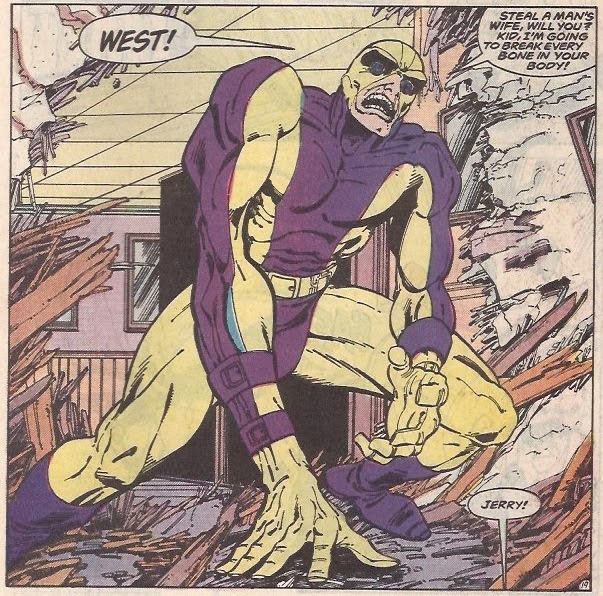
The plot of this narrative, which does not have a name but takes place in two issues titled “Speed McGee” and “Super Nature,” revolves around Wally being romantically involved with a married woman, and her completely insane husband’s misguided attempts to get revenge/win her back. She is Tina McGee, who the Flash met in a previous issue during some speed tests they conducted together in Utah. Her husband is Jerry McGee, a brilliant scientist whose most recent experiments have stolen his mind. He’s been researching steroids in an attempt to create new super-humans, and has even gone so far as to inject himself with the drugs, which have eaten away at his sanity. Now a rage-filled madman, Jerry finds himself losing Tina, who has become quite enamored of Wally since their initial encounter. Convinced that Wally is a threat to his marriage (which is essentially true) Jerry decides to do something about it, and creates a costume designed to regularly dose him with the experimental steroids and also uses various additional bits of sci-fi technology to further enhance his physical abilities. The result is a hulking, crazed beast of a man in purple-and-yellow spandex with super speed, ridiculous levels of strength, and a seemingly impenetrable tolerance for pain.

It is Jerry as a supervillain—the cover of issue #6 names him “Speed Demon” but nobody ever says that in-story so I’m just going to keep calling him “Jerry”—that provides the most impressive visuals. Jackson Guice (before he went by “Butch”) makes Jerry a truly horrific figure, his massive, warped body straining against the weight of its own might. When he bleeds, which is often, it is a viscous black, which may be partly thanks to colorist Shelley Eiber, but the sickeningly sticky texture, if not the dark hue, is certainly Guice’s work. In addition to his overstuffed size and shape, Jerry’s maniacal anger and over-confidence make him dominate every panel he’s in. He also dominates every fight, despite the Flash’s best efforts. No amount of high-speed punching is enough to even phase Jerry in his drug-enhanced state, so he trounces Wally a couple times, once to kidnap Tina back, and then later when he tries to murder his former boss, Dr. Bortz. Though Jerry doesn't succeed in getting Tina or killing Bortz, in neither case is it the Flash who actually foils his plans. No, it is Jerry’s own superpowers that thwart him, or rather his inability to keep them under control. When he snatches Tina and tries to run away with her, he accidentally charges full speed into a fuel depot, causing a massive explosion that, though Jerry survives, forces him to drop his wife. Later, the Flash tries to defend Bortz, so he and Jerry get into a fierce melee. Jerry quickly gets the upper hand, and is mere seconds away from snapping Wally’s spine when, all of a sudden, his body finally craps out on him after days of extra-strength steroids and reckless violence.

I’m quite fond of the idea of a supervillain who’s too powerful for his own britches. It’s pretty common for bad guys to seem impossible to beat at first, usually because this makes the hero’s eventual victory all the more satisfying. In this case though, Baron goes the opposite route, and I appreciate his commitment to making Jerry such a massive threat that the Flash never does figure out a way to save the day. Baron takes the common approach of creating an apparently insurmountable obstacle at the start of the story, but then surprises the reader by having the problem solve itself. The Flash is almost incidental to this tale, except that without him, Jerry would have no reason to become a ‘roided out super-lunatic. Also, Dr. Bortz might have died if the Flash was not around to defend him, though even that’s not for certain, since Bortz already had a weapon on hand specifically designed to deal with Jerry’s new powers. Having the Flash be such an insignificant player in his own book might turn some people off, but I don’t have a problem with it here because it fits with Baron’s general characterization of Wally as immature and inexperienced. He’s rash, he lacks forethought, he gets involved with a married woman eleven years his senior, he handles his newfound riches poorly, and so on. Failing to defeat Jerry goes right along with the rest of Wally’s shortcomings.

That’s the core of this narrative, and it’s a solid one. Baron and Guice construct Jerry as a convincingly terrifying new villain, and his brief, brutal story is atypical and artistically interesting enough to support the two issues it takes up. Where these comics fail to deliver, though, is in all the non-Jerry material. Baron can’t quite seem to strike a balance between the Jerry-vs.-Flash scenes and all the other storytelling that needs to take place. Wally’s scenes with Tina are consistently too short for their relationship to develop the way it ought to for this narrative to be at its best. Their romance is so new, their bond so thin, that without more room to see them get to know and care for one another, it’s hard to feel invested in them as a couple. This in turn makes the stakes seem lower, since the whole conflict is based on Wally and Jerry both wanting to be with Tina.

This is the most obvious example of Baron mismanaging things, because it’s a problem throughout the entire story, but there are other, more isolated instances as well. Wally’s dad shows up suddenly to crash at his son’s mansion with a flimsy-at-best explanation as to why. Then, once he’s settled in, the narrative forgets about him completely, and he’s not seen again for the duration of this story-line. Later, after Jerry’s first attack, Wally contacts his teammates in the Teen Titans to have them protect Tina, which they do for about three pages, even flying her out to Titans Tower. But almost as soon as she arrives, Tina decides she doesn't want to stay in the safe, secure environment if it means being apart from Wally, so he agrees to take her back, making the entire trip essentially pointless. It comes across as Baron feeling obligated to address why Wally isn't turning to his friends for help, rather than having a legitimate story reason for including them. The ending leaves a lot to be desired, too. While, as I said, I’m a fan of Jerry taking himself down, it does happen rather abruptly. Afterwards, there’s a rushed, jumpy final few scenes, hurriedly tying up the story’s loose ends before charging right into a teaser for the book’s next arc. It’s a bungled closing beat, not given the proper space to do everything it wants to do.

Basically, anything in this narrative not directly related to Jerry’s destructive (and self-destructive) streak is given the short shrift. Which is too bad, but better a lack of balance than a lack of anything interesting at all. Jerry is an intense, fascinating villain who brings some unusual and unexpected elements to this comic, and that on its own makes these issues worth reading. They’d be even more enjoyable if Baron could more deftly juggle all the balls he has in the air, but both he and Guice put their focus on a single character instead, making him memorable and immensely entertaining, but only at the rest of the tale’s expense.