Showing posts with label 1987 and all that. Show all posts

Friday, March 28, 2014

1987 and all that 025: this is it

by Matt Derman

Dakota North #5 (Marvel)
By Martha Thomases, Tony Salmons, Max Scheele, and John Morrelli

Before I properly get into the comics criticism, a bit of quick housekeeping. This will be the final installment of “1987 And All That” to appear here on The Chemical Box. As they explained in Episode 24 a couple weeks back, Joey and Alec have decided to stop with written content on the site, so I’ll be wishing them both well in all their future endeavors, and transporting this column over to the good folks at Comics Should Be Good. So look for more 1987 goodness over on that site starting next month.

For my last Chemical Box piece, I figured it’d be appropriate to go with the last issue of a series, and lucky for me 'Dakota North' #5 was not only the title’s final issue, but also the only one published in 1987, coming in just under the wire with a February cover date.  I’m not really familiar with the book or the content of it's first four issues, but writer Martha Thomases gets a lot of credit for filling this final chapter with fairly seamless exposition. There are several characters who only know some of the history and/or only understand part of the present goings-on, so a there are a lot of explanations in the dialogue, but few if any fall into the trap of having one character tell another something they both already know.  Though some of the finer details of what happened before aren’t covered, the long and short of the situation is this: Dakota North, her younger brother Ricky, and her cop friend/love interest Amos have been kidnapped by the evil Sheik Ibn Bheik because he wants to steal the pen full of nerve gas that Ricky has concealed somewhere on his body. Ibn Bheik is working with another foe of Dakota’s named Cleo, though the exact significance of that isn't really delved into. Dakota and company have to break free of Ibn Bheik’s grasp before he can find out where Ricky is hiding the pen, while at the same time Dakota and Ricky’s father S.J. tries to use what is clearly his own romantic history with Cleo to save his kids from that side of the conflict. It sounds a little convoluted when I write it all out like that, but in practice it boils down to the good guys escaping the bad guys in a classic kidnapping scenario. The heroes are literally tied to chairs with ropes on the very first page. It could not be more straightforward.

Unfortunately, the same simplicity that makes this story so easy to understand also prevents it from ever feeling significant or worth any real emotional engagement or investment. To be fair, perhaps I’d have more of a reason to care if I didn't come in four issues deep. But within the pages of this particular issue, nobody in the cast stands out as especially interesting or three-dimensional, and the action is too silly and bogged down with text to ever truly excite. The stakes also don’t feel all that high, in no small part because many of the key players seem to take everything as a joke. Ricky, the young man who’s actually responsible for the potentially devastating nerve gas pen, is more interested in watching cartoons than getting away from his kidnappers or keeping the nerve gas out of their hands. And for a primary antagonist, Ibn Bheik is too much a passive spectator. He spends a lot of the issue with a wide, dumb grin on his face while watching his pet bird get bested in combat by Dakota, who subsequently beats up Ibn Bheik and all of his lackeys with ease before getting away. Had he been a more active participant, actually pursuing his wicked agenda instead of just talking about it from a distance, Ibn Bheik might have added some fear or urgency to the narrative. As it is, he’s more of a clown, just a large, inept doofus for Dakota to trounce. He even causes his own demise in the end, when one of his henchmen manages to steal the nerve gas pen from Ricky, but then decides to use the pen to take control of Ibn Bheik’s criminal operation. The Sheik and his minion fight over the device and it breaks, exposing only the room full of villains to the instantly fatal gas. From start to finish, Ibn Bheik is the least threatening, least serious baddie he can be.

Along the same lines, Dakota North makes for quite the grating hero. She’s not entirely unsympathetic, but there doesn't appear to be any effort spent toward making her all that likable either. She’s abrasively snarky, and not in a good-humored way, but instead motivated by her constant impatience with others and complete, almost arrogant confidence in herself. I don’t mind having a tough, brave, no-nonsense lead character, but there has to be a balance, because if all of the hero’s lines are aggressive, insulting, and mean, it becomes progressively harder to root for them. I don’t know if Dakota is quite that bad, but she’s right on the border, taking herself way too seriously and coming across as cold and callous rather than merely focused. When she discovers the villains’ dead bodies at the end of the issue, her reaction is detached and stiffly sarcastic, like she’s neither happy nor sad that her enemies died, because she thought so little of them to begin with. That’s too harsh and angry a personality for me to understand or empathize with, meaning Dakota never fully has me in her corner.

Her father S.J. is troublesome in the same way. He’s clearly a devoted dad, willing to do anything to save his kids, and that I like. But he’s always so fired up, ever the cantankerous old man, with no moments of calm or thoughtfulness in between. He’s turned up to eleven, in an incessant state of flustered fury, and it makes him into a caricature instead of a real character. I suppose that’s true of most of the cast actually. They’re all too broad for anyone to be believable, but the story itself isn't nearly as wacky as the characters. While the narrative wants to be dramatic action-adventure, the people in it behave more like the ensemble of a goofball slapstick comedy, and those two worlds never merge satisfactorily.

By far the most jarring and legitimately amusing moment in the issue came at the very, very end, not even in the last panel but underneath it. After ending on a bit of a cliffhanger, the issue closes with the following sentence: “This is where we usually put the blurb for the next issue, if there was a next issue, but there isn't.” That’s as impressive as it is obnoxious, bold in it's honesty but aggravating in its suddenness. The story doesn't end, does not even attempt to tie up all of its loose ends, but then the series unapologetically crashes to a halt anyway. I assume this is a case where the cancellation order came in after the script for this issue was already done, or close enough to done that trying to cram in a complete conclusion would have been worse than the ending they went with. Whatever the external circumstances though, that final sentence certainly comes out of nowhere in the issue itself. I admire the creators’ willingness to end in such a surprising, possibly upsetting way, and the brazenness with which they do it. If you’re going to wrap up a series in the middle of the story, might as well be as transparent about it as possible.


Most of the time, if I read a comic this void of meaty material, it irks me strongly for having wasted my time, but 'Dakota North' #5 isn't even bad enough to illicit that powerful a response. It is so empty and silly that to feel any real anger toward it would be more emotional energy on my part than it’s worth. What I do feel is more akin to pity, like, “Poor little comic book, couldn't even figure out its voice before suffering an untimely demise.”

Friday, March 7, 2014

1987 and all that 024: big kid

by Matt Derman

...reading comics from the year i was born!

Mephisto Vs. #1-4 (Marvel)
By Al Migrom, John Buscema, Bob Wiacek, George Roussos, and Rick Parker

'Mephisto Vs.'  is an odd duck. I completely understand the impulse to pit the Marvel Universe’s version of Satan against some of its premier super-teams. That makes perfect sense and sounds pretty cool, if perhaps overly simple. What I’m less clear on is why in this story Mephisto is characterized as a petulant child. Has he always behaved this way? I admit I’m not overly familiar with Mephisto, but I think of him as being very grim and stern and aloof. Though stranger, I far prefer the Mephisto of this series who, while he has an obnoxious temper, is also playful, chatty, and often hilarious. He’s a little kid, collecting and playing with toys, arguing with his parents, upset because his sister stole his things and messed up his room. That’s an amusing personality for an uber-powerful supervillain to have, because unlike most spoiled children, this one actually has the ability to get his way.

The plot of 'Mephisto Vs.' is either exceedingly straightforward or needlessly complex, depending on how you look at it. All Mephisto wants to do is get back at Hela, his Norse mythology counterpart, for breaking their jurisdictional agreement and stealing human souls from him. Hela is only supposed to get the souls of Norse gods, apparently, while evil humans go to Mephisto, and he’s pissed that she broke the rules. He also worries that if she gets her hands on too many human souls, she’ll have enough to challenge him, sending her souls against his in an attempt to take his realm from him for good. So he sets out to stop her, and to preemptively give himself the upper hand should that confrontation between them ever occur. That’s simple enough in theory, but the execution of Mephisto’s plan is tangled and hard to follow, especially because his true motive is not revealed until more than halfway through the story. Also, the real purpose of this series is just to have Mephisto fight a bunch of different heroes, so the plot that ties those fights together isn't necessarily the point, and therefore not all that carefully constructed. 

Mephisto begins by going after the Fantastic Four. He kidnaps them all and brings them to his kingdom, and then proceeds to torture them one-by-one until only Sue Richards is left intact. Then, as demons and devils are wont to do, he offers Sue a deal: her soul in exchange for the release of her family. Sue of course agrees, and stays behind as Mephisto’s prisoner while the rest of the FF return home. From that point on, Mephisto continues to trade one superhero soul for another, each time getting a slightly more valuable soul than before. So he gives up Sue Richards for Jean Grey, because mutant souls are better than human, apparently. He then lets Jean go, but only after acquiring the souls of several X-Men at once by just capturing Rogue (because Rogue had touched her teammates and absorbed their essences into herself in a desperate attempt to save them from Mephisto). Only Rogue is permanently trapped, however, since Mephisto loses control over the other X-Men’s souls once Rogue’s touch wears off and their personalities and powers return to them. Rogue is all Mephisto needs anyway, because what he really wants is to get his hands on Thor, what with Thor being a god and therefore having the purest, most powerful kind of soul. Mephisto forces Rogue to come in contact with an unconscious Thor, driving Thor’s soul from his body so Mephisto can trap it. But it turns out Thor’s soul is too stubborn and mighty to be kept down by even one as powerful as Mephisto, so in the end Thor breaks free and Mephisto is left with nothing.  

At each step in this better-and-better-souls scheme, Mephisto explains out loud and with some verbosity what he’s doing, how, and why. The problem is, none of what Mephisto says is necessarily true. As evil incarnate, he uses an awful lot of deceit to get what he’s after, so he’ll often lay out his reasons for doing something quite clearly one issue, only to backpedal the next and say that, no, he was lying before, and his real reasons for doing whatever he did were entirely different. Initially, he says he’s attacking the Fantastic Four to get back at little Franklin Richards for hurting him in a previous conflict. It’s not until 'Mephisto Vs.' #2 that the idea of gradually gathering souls of higher and higher quality is introduced, and even then Mephisto’s endgame is kept obscure. The final issue is when we finally learn that the whole affair is Mephisto trying to stick it to Hela for an earlier slight, which is why Thor is his actual target. According to the current rules, Thor’s soul would go to Hela after he died, so Mephisto claims he wants to steal it now, robbing Hela of a powerful addition to her own collection of souls and also better preparing himself to fight her should she make her move against him in the future. But then, at the very, very end of the series, there is yet another exposition twist, when Mephisto explains (to no one in particular) that even that wasn't his real plan. All he truly aimed to do was make Hela think he wanted Thor’s soul, so that she would insist on keeping it for herself, and then someday, if/when Thor actually dies, Hela will be the one who has to deal with trying to control his overpowered, rebellious spirit.

I hear your cries, But why would Mephisto need to trick Hela into keeping a soul that was already going to be hers eventually? And boy do I wish I had an answer to that question, but I don’t believe there are any to be found. By the time Mephisto divulged that final detail, he had already flip-flopped and re-explained himself so many times that trying to suss out what he actually accomplished (if he in fact accomplished anything) seemed like it would be exhausting and futile. Especially because I know full well that giving Mephisto a legitimate reason to encounter all these different super-people was not this comic’s primary concern. Also, his constant lying and mind-changing goes well with the rest of how he’s portrayed here, namely as a rotten brat of a kid who’s having the longest, silliest tantrum ever.

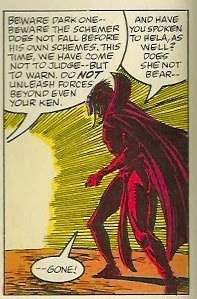
Mephisto is not literally depicted as a child, it should be noted at this point; he just acts like one. I mean, this whole narrative is basically Mephisto pitching a fit over Hela taking his toys without asking. At one point The Living Tribunal shows up to warn Mephisto about the dangers of the game he’s playing, and the dialogue is very much that of a parent scolding a kid. The Tribunal stays calm and direct, but has a hard time penetrating Mephisto’s fussy fury. Mephisto’s arguments, meanwhile, basically boil down to, “It’s not fair!” and, “Why aren’t you yelling at Hela?” two classic childhood tactics that get the same lack of results here as they typically do in the real world. He sees the souls he takes as his playthings, literally referring to them as “pawns,” and delights in his control over them. It’s the selfish joy of a kid with his favorite toys. Even when battling the heroes directly, ostensibly bringing himself to their level, he plays the role of schoolyard bully, pushing around and teasing the weaker kids just because he can. This immaturity is a somewhat ill-fitting contrast to Mephisto’s power level and the intricacy of his plan, but it adds levity to the series that I think it needs. It also gives the reader one constant truth to hang onto in the sea of Mephisto’s lies. No matter what he says he’s doing or how he tries to paint himself, Mephisto can be counted on to act childishly.

Here I am carrying on about the plot and Mephisto’s personality, when at the end of the day none of that is really why anyone would have any interest in this comic. Like Mephisto himself, I’m dancing around the truth, which is that the best reason—maybe the only good reason—to read 'Mephisto Vs.' is to see John Buscema draw so much of the Marvel U all in one book. Also, Buscema helped create Mephisto, and draws him incredibly well, really selling him as a viable star of a series, even if it is just four issues long. Buscema gets to do whole issues worth of the Fantastic Four, X-Factor (back when they were the original X-Men pretending to be mutant hunters), the X-Men, and both the East and West Cost Avengers teams. There’s also The Living Tribunal, Hela, a whole bunch of crazy and/or goofy demons, and one great flashback panel of the Silver Surfer, and everybody looks amazing. Buscema is such a professional talent; he’s equally comfortable with the lineups of all these teams and more. His settings are varied and detailed, most impressively Mephisto’s kingdom, which is richly textured despite being desolate. His strongest work comes when Mephisto is tormenting the heroes. There’s a standout moment in every issue: the full-page splash of Mephisto kissing Rogue, the horrified puddle face of a melted Iceman, Mephisto’s crazy extended arm grasping Wonder Man’s throat, and best of all, Mephisto peeling the rocky skin off of The Thing to expose a paper-thin soul underneath. Buscema is inventive in his combat choreography, never having Mephisto use the exact same trick twice, because his powers are so many and so mighty that he has no need to repeat himself. If nothing else, it keeps the comic from growing stale, and that plus the ever-changing cast makes each issue visually distinct from the others, so all four are worth it if you’re into the art. Come for the Buscema, stay for the Buscema.

'Mephisto Vs.' is not a bad comic book, or at least not as bad as it very well could’ve been considering it's openly gimmicky nature. The conflict of Mephisto being the most powerful but least grown-up character is highly amusing, Buscema makes everything look nice and classic, and though the plot is wonky, there’s no pretense that it was at all the top priority. Four issues is the perfect length for this sort of thing, although I do wonder how much it would have suffered if the X-Factor chapter had been removed completely. It’s the least connected issue, and it features the least established team, though the cast are the founding X-Men so I guess that’s debatable. In any case, four issues feels right, enough space to display the full range of Mephisto’s powers but not so much that it runs out of steam. I wouldn't call this a good comic book either, but it’s fine and it’s fun and it’s not trying to be anything more than that. It’s a curiosity, and even without offering much of substance, it manages to be well worth a look.

Friday, February 21, 2014

1987 and all that 023: two years in a year

by Matt Derman

...reading comics from the year i was born!

Batman #404-407 (DC)
by Frank Miller, David Mazzucchelli, Richmond Lewis, Todd Klein

and

Detective Comics #575-578 (DC)
by Mike W. Barr, Alan  Davis, Paul Neary, Todd McFarlane, Alfredo Alcala, Adrienne Roy, Richard Starkings, Agustin Mas, John Costanza, Todd Klein

I have officially been writing these “1987 And All That” columns for a full year now, which is pretty cool. I thought I would celebrate the occasion by reading one of 1987’s most beloved stories, and an especially appropriate tale to mark a one-year anniversary, 'Batman: Year One.' But then I thought, hey, if I’m doing that, I might as well keep going and read 'Batman: Year Two' as well, since it was published immediately after “Year One,” just in a different book and with different creators. Having read both stories before, I knew they had almost nothing to do with one another, and that “Year One” was excellent while “Year Two” stunk. Yet it still seemed like it might be fun to read them back-to-back, and then examine them side-by-side to see exactly what makes them so dramatically different from one another in quality. There are, of course, many reasons, but what it all boils down to is this: while released one right after the other and both technically canon at the time, these two stories are about two entirely different versions of Batman, not from the same world as each other or in any discernible way even the same person.

This division between the two begins with the simple fact that “Year One” is a retelling while “Year Two” is an original story (Editors Note: Technically, it is actually supposed to be a retelling of this story, but how well it does that is debatable -- Joey). Though it has a powerful, singular voice, and adds plenty of new details, “Year One” is still covering old, established ground. Bruce Wayne returns to Gotham with a plan, and after the famous bat-crashing-through-the-window moment of inspiration, he dons his cape and cowl and becomes the city’s Dark Knight. It’s the core of what Batman is, the essential narrative. The summary for “Year Two” sounds more like fan fiction or something similarly experimental and ridiculous. A man named The Reaper, who apparently used to be like a lethal Batman in Gotham twenty years ago, shows up again and starts killing anyone he thinks deserves it, which is more or less just anyone. Batman gets so frustrated by this Reaper jerk that he starts using a gun and teams up with criminals. That’s bad enough, but it gets worse, because the gun he uses is the actual gun that killed his parents. That’s right, all these years, Bruce Wayne has secretly been holding onto the murder weapon, I guess waiting for a special occasion. And even more foolish than that, the crook he partners with is also the man that killed his parents! This is such an outrageous idea, that Batman would not only compromise all of his values after one fight with one villain, but do it with the help of very weapon and person that caused the tragedy which gave him those values in the first place…it’s almost admirable in its brazenness. But it’s a far cry from something as fundamental as “Year One.”

In “Year One,” both writer Frank Miller and artist David Mazzucchelli bring an old-school noir feel to the whole affair that fits with the classic nature of the story. The real star isn't even really Batman but Jim Gordon, the hard-boiled, stand-up cop trying to survive in a corrupt new city. The two men share a lot of parallel experiences in their individual struggles against Gotham’s greatest evils, but Gordon’s story packs more of an emotional punch. He has the strained marriage, the illicit romance, the near-loss of his infant son. He holds things together through his humanity, while Bruce becomes something slightly other than human. Giving the reader a more grounded character with more personal problems to latch onto allows Miller to take his time with things. Gordon narrates a lot, with Bruce filling in most of the gaps, and the constant insight into their thoughts adds detail and heft to everything. When one of them wrestles with a decision or learns a hard lesson, the reader goes through every agonizing step of the process with them. Yet the pacing is lively enough, and Miller’s writing is so efficient, that there’s no sense of things being slowed or over-explained. We get the perfect amount of information, relayed with precision, so that every beat of every issue is given ample room.

Meanwhile, “Year Two” is an exercise in rushed, hand-waving narration. Batman goes from meeting the Reaper to pulling out the gun that killed his parents by the end of the first issue, and the end of the second is when he teams up with Joe Chill, his parents’ murderer. There are a few narrative captions worth of inner turmoil about it, but Batman quickly reaffirms that he thinks working with villains is the only way to stop the Reaper, so he has no significant reaction to Chill and they just go ahead and work together. It goes too far into hard-to-swallow territory, and without even trying to take the time to sell it. The reader is asked to accept something so implausible just because it’s happening, not because we have been given a reason to believe.

There’s other stuff crammed in there too. Bruce Wayne meets Rachel Caspian, who is days away from taking her final vows as a nun, and charms her out of it over the course of a single date. He meets her father on their next date (who is weirdly fine with his daughter giving up her whole life plan for a man she just met), and on their third date they get engaged. It’d be one thing if Bruce and Rachel had a natural, wonderful rapport with each other, though even then their romance would be moving at a dizzying speed. But their interactions are brief, strangely formal, and never at all playful or affectionate or in any way resembling love. Why include such an awkward romance? Because Rachel’s father is, unbelievably enough, the Reaper himself, which only matters insofar as she goes back to being a nun once he is unmasked as Gotham’s worst killer, to atone for his sins. It’s just one final blow for the Reaper to deliver to Batman, a hit neither of them anticipated. Not a bad idea, but executed poorly.

That’s a good way to describe all of “Year Two,” at least at the most basic conceptual level. I like the notion that, in his second year of costumed crime fighting, when faced with an enemy more wicked and powerful than any he’d seen before, Batman might go a little nutty and resort to reprehensible and reckless tactics. If things had stopped at that point, it might’ve been a worthwhile read. But to bring in all this needless stuff with Joe Chill and the gun, and the wedged-in plot with Rachel, and even having the Reaper be an old vigilante returning after decades of inactivity…it’s too much, and handled badly. Which is difficult to get past, especially after reading “Year One,” the story of all of Bruce’s years of training and focus finally coming together. “Year Two” is about all of it coming apart in almost no time at all, and it doesn’t earn that dismemberment of the character, that rapid unraveling of the incredibly tight work done in “Year One.” If more time had been taken, and more thought put into things, watching Bruce become unhinged under the pressure of his mission could have been entertaining as hell. I have seen that done before and likely will again. “Year Two” is just too much reason-less shark-jumping with nothing to back it up.

Miller and Mazzucchelli, as I mentioned, deliver a cohesive atmosphere to their story. And it’s worth noting they work with a single colorist, Richmond Lewis, and only one letterer as well, Todd Klein. A small, steady team. Though “Year Two” is written by Mike Barr alone, the first issue has Alan Davis and Paul Neary on art, while Todd McFarlane and Alan Alcala handle the rest. Oh, except, no, I’m looking again now, and it turns out Alcala isn't on the final issue, so McFarlane must ink himself on that one. Adrienne Roy is the sole colorist, bringing at least some visual consistency, but then there’s a different letterer each issue. Not that it makes an enormous, starkly obvious difference, but it does make some impact, and the point is that there’s way less creative stability in “Year Two,” which may account for some of its problems with timing and tone. There’s clarity of vision in “Year One” while “Year Two” is messier from start to finish.

As a final point of contrast, Miller and Barr write their Batmans (Batmen?) very differently as characters. Miller’s is stoic, largely silent, and when he speaks it is with intentional, almost theatrical gravitas. He cares obsessively about his fight for good, but carefully considers every move and mistake he makes. Barr’s Batman is much chattier, and more snarky than somber. He’s also friendlier, as Batman and Bruce Wayne both. He gives Gordon a pipe as a present, has casual meals with Rachel and Leslie Thompkins, and is just generally more engaged with people, less tucked away from the world. He’s also rasher, and less patient or reasonable. His craziness runs deeper, and it makes him wild and hard to predict. Miller’s Batman is angry but disciplined; Barr’s is out of control.

The only logical conclusion I can come to, the only way I can reconcile these two stories, is to think of them as existing in distinct universes. These are not narratives about the same man living through two consecutive years of his life, but, instead, they’re wholly separate tales. They both feature spins on the same character, sure, but there’s nothing connecting them to each other beyond that. And there are actually some in-story facts to back up this interpretation. Bruce Wayne is twenty-five in “Year One,” but then in “Year Two” he describes Joe Chill as “the man who, twenty-five years ago, created the Batman…” Now, I’m no Batman historian, but based on the fact that he could walk and talk and understand The Mark of Zorro, I am going to guess Bruce was older than one when his parents got shot, so those two things don’t quite line up. Also, Leslie Thompkins is not a character in “Year One” at all, but she’s an everyday part of Bruce’s life in “Year Two,” and privy to the fact that he’s Batman. Finally, and for me this is the big one, the very last thing that happens to Gordon in “Year One” is he gets promoted to captain. Then, pretty much the very first thing we learn about him in “Year Two” is that he’s just been made commissioner. Even if several months passed between the two stories, hell, even if “Year Two” is really just “December of Year Two,” it makes no sense that Gordon would get another promotion that quickly, no matter how beloved he is. I just don’t see any way that these two stories could be reasonably seen as tying into one another.

Plus, there is always the matter of “Year One” being published in 'Batman' while “Year Two” got 'Detective Comics'. I’m not knocking Detective, because historically I think it may have the better track record, but 'Batman' feels more official. And whichever you prefer, that the two stories weren't published under the same title definitely makes it easier to think of them as fully disconnected. Two different books, two different creative teams, therefore two completely different worlds. Both of those worlds have a Batman, yes, but one of them is great while the other’s a dud.

Friday, January 31, 2014

1987 and all that 022: two guys, zero purpose

by Matt Derman

...reading comics from the year i was born!

Kobier and Oso: The Adventures of Two Guys #1 (Gebhart)
by Brad, Chris, and Matt Gebhart

Sometimes you read a comic and it makes you feel nothing. To me, this is worse than a comic that fills me with rage or embarrassment or even disgust, because at least in those cases the comic is doing something. I’d rather read a terrible book that gets me worked up with its awfulness than one that just bores me and leaves no impression at all. Sadly, 'Kobier and Oso: The Adventures of Two Guys' falls firmly in the latter category. With all three creators and the publishing company bearing the name Gebhart, it seems safe to assume that this comic is a familial vanity project, something the Gebhart boys thought was worth putting out even if nobody else in the world agreed. What it reads like is a practice run, or something made by kids who are aspiring to be comic book creators but have yet to grasp the fundamentals of storytelling. With the thinnest plot and characters I’ve ever seen, sparse and rough black-and-white artwork, and a bizarre sense of humor that never quite finds its voice, Kobier and Oso offers nothing of substance.

Here’s as detailed a plot summary as I can put together: the title characters are a human and a dwarf living in a medieval fantasy world and adventuring together. On the very first page, they find the keep that they have apparently been looking for, though why they’re looking for it is never explained. They enter the keep, have a series of encounters that feel like the world’s most basic D&D session, get captured, escape somewhat inexplicably, and then the book abruptly ends. Its light, but it could theoretically be enough for some interesting character development and/or impressive action and/or solid comedy to take place. Instead, both heroes speak in the same stilted and weirdly formal voice, all the fights are dull and too brief, and the few jokes that pop up are poorly timed and weak.

The dialogue between Kobier and Oso is definitely one of the most frustrating aspects of the book, because there’s almost no distinguishing between the two of them, and neither has a voice that sounds natural. At times, it seems like the idea is to have Kobier be a sort of surfer/stoner character, using words like "dude", "man", and "like", but it doesn't happen that often and nothing else that he says or does really fits with this characterization. I guess it’s possible the Gebharts thought that throwing in a few bits of casual slang would be enough, but because those words clash with the rest of his dialogue, the result is a character whose personality is impossible to pin down. Is he a badass warrior, an easy-going bro, or something in between? As for Oso, he’s curmudgeonly (as dwarves are expected to be, I guess) but his grumpiness seems to have only about two levels: slightly irritated and totally frustrated. It’s rare that he tips all the way over into actual anger, which makes his generally foul mood pack less of a punch, since there’s no real threat that it’ll lead anywhere interesting. He may get annoyed by Kobier at times, but that never changes anything or affects what they do in any noticeable way, so who cares?

The pair of adventurers deal with obstacles like an invisible pit, a gang of goblin children, an attack from several large “crab spiders,” and the creepy hulking creatures that guard the keep. While each of these problems presents a slightly different kind of challenge, and therefore they each have a unique solution, none of them are complex or original enough to be interesting. Invisible pit? Kobier climbs it and Oso leaps across. Goblin kids? They’re kids, so the heroes just walk away from them after getting some helpful information. Crab spiders? The good guys beat them in not-all-that-well-drawn combat. As for the guards, at first Kobier and Oso try to run away, but they end up surrounded, so they give up immediately and get taken prisoner. Then just a few pages later, after learning that prisoners in this keep are fed to a demon, Kobier and Oso fight and win against more or less the same number of guards that they surrendered to earlier. Why did they let themselves get captured at all if they could have just fought their way out? No reason I can find except that it took up more pages this way. Although…it’s a 33-page comic with nothing of value in it, so it didn't really need that sort of filler material.

Chris and Matt Gebhart are credited with the story of the issue, while Brad Gebhart is responsible for basically everything else (editing, pencils, inks, letters). I mention this for two reasons. First of all, I seriously can’t believe it took two people to write this comic. It makes me wonder if maybe Chris and Matt are like Brad’s sons or something, and Kobier and Oso is just a make-believe game they sometimes played with their wooden swords or action figures or whatever, and then daddy Brad made it into a comic book just for kicks. That, at least, would be an acceptable explanation, whereas three adults collaborating to produce something so empty is harder to swallow. Secondly, I want to take a minute to address Brad’s art, because it’s arguably the best part of the issue, though that’s not saying much at all.

Visually, Kobier and Oso is as simple and dull as the narrative overall, but there are some specific things I liked that deserve to be pointed out, even in the midst of all this negativity. Brad’s designs for the crab spiders and for the keep’s guards worked for me as far as fantasy monsters go. The crab spiders looked exactly the way they should based on their name, and the guards were somewhat reminiscent of the Creature from the Black Lagoon, but a bit stouter and more muscular so they were appropriately scary-looking. I also quite enjoyed Oso’s look, which wasn't the traditional bearded and full-bellied dwarf that you see in pretty much every other fantasy setting ever. He’s totally hairless instead, and more wide than fat, plus he has strange pointy ears that are usually reserved for elves. Also, giving him a morning star instead of an axe or warhammer was a nice touch, since it’s still a recognizable weapon and one that fits his character, but not exactly what you’d expect. Kobier, unfortunately, is just your standard long-haired shirtless human fighter.

The best bit in the art, though, was also the funniest joke in the issue, a pretty dumb little visual gag but one that at least got a smile out of me. Kobier and Oso’s rations are basically just peanut M&M’s, but because, of course, they can’t be real M&M’s for legal reasons, they’re N&N’s, with Brad copying the style/font of the real M&M’s logo but using a different letter. It’s so minor, and not even the first time I've seen something like this done (Let’s potato chips, anyone?), but Brad does a pretty great job of mimicking the real-world logo, and it’s the most detailed work he does in the whole book.

In places, it seems like what Kobier and Oso wants to be is the fantasy genre equivalent of a buddy cop comedy—two mismatched guys teaming up to fight evil, stumbling through the process but winning in the end. That’s not a bad concept, but the execution is not just amateur, it’s immature. There’s no narrative momentum or destination, just a string of events that happen back-to-back, and we don’t even find out why the heroes of the story are doing what they’re doing in the first place. Kobier and Oso is a meal of marshmallows, and while I hope the Gebhart gang had fun putting it together, it probably would have been better if they’d kept it in the family, rather than powering ahead and self-publishing such lightweight junk.

Before I wrap this post up, I’d like to end on a slightly more upbeat note, so let’s look quickly at the two series that are teased on Kobier and Oso’s inside back cover, but probably never saw the light of day. At the bottom of the page is 'The Brood', which looks like a generic superhero team book that I couldn't care less about. But above that is 'YoYoMan the Researcher', which piques my interest more than anything else in this entire comic book. There’s no real information given, just a hilarious picture of the title character, but the name alone is enough to excite me, because it’s got to be in the top 5 all-time best/funniest superhero names I've ever heard. Does he research yo-yos? And is that how he became a superhero, a yo-yo research accident? Are his powers strictly yo-yo-based, or does he have superhuman research skills as well? Or is researcher just his day job, but he decided to include it in his superhero moniker, too, for some ridiculous reason? That I’ll never get answers to these questions is aggravating, but I’m grateful for the image that inspired them all the same.

Friday, January 17, 2014

1987 and all that 021: teach them well and let them lead the way

by Matt Derman

...reading comics from the year i was born!

Young All-Stars #1-7 (DC)
by Roy Thomas, Dann Thomas, Brian Murray, Michael Bair, Vince Argondezzi, Howard Simpson, Howard Bender, Malcolm Jones III, et al.

The circumstances that surround the formation of the 'Young All-Stars' make them somewhat unappealing as the stars of their own series. They don’t really want to work together, don’t share any common goals, and don’t like or respect or trust one another. And technically they’re just a tiny subset of a much larger, more established, more impressive superhero team, the 'All-Star Squadron'. None of that sets them up to be especially compelling protagonists, because petty bickering between superheroes who need adult supervision doesn't stay interesting for long. It takes three issues for the team to even be created, and then it happens kind of suddenly and for the flimsiest of reasons. Afterwards, the kids have a mighty hard time coalescing as a group, never quite all getting on the same page at the same time, which makes the series as a whole feel like it’s struggling to find it's identity, too.

Part of the problem is that the 'All-Star Squadron' is necessarily a major part of this book, even though (or maybe because) 'Young All-Stars' was meant as a replacement to 'All-Star Squadron'. Partly, I’m sure, in order to bring fans over from one book to the other, and partly because the 'Young All-Stars' need lots of coaching, some number of adult All-Stars are featured in every issue of these initial seven from 1987. They’re not just background players, either. At first, they’re just as important to what happens as any of the supposed stars of the book, and even when they slide into more supporting roles, they still act as guides/bosses/leaders to the 'Young All-Stars', telling them where to go and what to do and how to do it. This forces the creators to give the adult All-Stars room to do their thing, which in turn steals valuable story/page space from the series’ main characters. And since several of those characters are new and none of them are very well-known, they need all the room they can get to be properly introduced and developed.

That being said, it’s a decent enough core cast when you take them individually, though not everyone is equally likable, and everybody’s got at least one aspect of his/her character that bothers me. The most annoying is probably Tsunami. I get that she is meant to be a lens through which to view America’s racism during WWII, but it’d be nice if she could ever play any role other than that. She is an endless stream of heartfelt arguments against internment camps for Japanese citizens, and while I agree with her stance 100%, hearing about it for a few pages of every issue with no progress ever being made grows tiresome fast. Her only other job is to reiterate her life story, because she used to be an enemy of the 'All-Star Squadron', so she has to constantly re-explain why she’s a good guy now. She is regularly the most repetitive and least relevant character in the book.

A close second for worst Young All-Star is Neptune Perkins, who isn't actively obnoxious like Tsunami but, instead, is so passive that I sort of wonder why he’s included at all. His abilities are ill-defined and unimpressive in action (basically he’s just a crazy good swimmer) and his personality is as bland as they come. His main function within these issues is to vouch for Tsunami, since he evidently knows her from being somehow involved when she and the All-Stars first clashed. Tsunami convinces Neptune first that she’s had a change of heart, and he then accompanies her everywhere else she goes, defending her vigorously from anyone they encounter who questions her trustworthiness. Why is he so quick to believe her? It’s not made clear, but if I had to guess, I’d say he probably has some innate attraction to her since she’s another superhuman with water-based powers. Also, he seems like a pretty trusting fellow anyway, open-hearted and open-minded across the board. The real reason, though, is that somebody who’s already accepted as a good guy needs to buy Tsunami’s story so that she can be brought into the fold with the rest of the heroes. Neptune was available, young enough to be part of the cast, and because of their aquatic abilities and history with one another, he made sense as Tsunami’s first point of contact. That doesn't leave him with much to do once she’s officially accepted as a hero and made part of a team with him, though.

Going in the other direction, if I had to pick a favorite Young All-Star it would be Dyna-Mite. Technically a member of the main 'All-Star Squadron' when this series begins, his grown-up mentor/partner TNT dies early on, leaving Dyna-Mite as a sidekick without a side. Also, without TNT around, Dyna-Mite believe that his own superpowers have been rendered useless, since in order to activate them he and TNT always had to fist-bump their special rings together. So he mourns the loss of his closest friend and his extraordinary abilities at once, making him the cast member with the most going on, emotionally. He has a real tragedy to deal with, and an identity crisis, too, since he has to decide whether or not to stay in the costumed hero game without any powers. It’s not a new struggle for superhero comics, but it’s played well in this book, with Dyna-Mite’s relative youth and the enormity of his loss combining to make him an engagingly tragic figure. His personal story arc is the closest thing to a hook 'Young All-Stars' really offers, and the moment in issue #6 where he discovers that he can press both rings together himself to turn on his powers is a definite high point. Sadly, it also takes away one of the things that made Dyna-Mite so interesting, but by then he’s established himself as the best-developed member of the team, the fullest, richest, most human character in the series.

Tsunami, Neptune, and Dyna-Mite were all characters who had appeared in comics before 'Young All-Stars' debuted, though they weren't the most popular by any stretch. Joining these three fairly obscure and underused young heroes are three brand new characters created for this book. After 'Crisis on Infinite Earths' changed history so that WWII-era America didn't have a Superman, Batman, or Wonder Woman yet, DC apparently thought it would be a good idea to create replacements for the Trinity in that time period in the form of new super-powered teenagers. The closest to the original, at least in terms of power, is Superman’s stand-in Arn “Iron” Munro. He doesn't have flight or any special visions, and there’s a grey streak in his hair, but otherwise he could pretty much be Superboy in normal clothes---incredible strength, great leaps in single bounds, jet-black hair, square jaw, etc. He’s more of a jackass than Clark Kent ever was though, brash and full of himself and weirdly, aggressively secretive about his origins. He’s also a somewhat reluctant member of the team, not naturally drawn to the superhero lifestyle (hence his lack of costume). He agrees to be a Young All-Star mostly because he and Dyna-Mite form a bond with one another quickly, since Iron saves Dyna-Mite’s life during the same incident that kills TNT. When the time comes to form a new team, Dyna-Mite is eager to have Iron be a part of it, so he begrudgingly sticks around, though once in a while he’ll remind everybody how he doesn't really want to be a superhero. It’s grating, but other than that he’s an OK guy, trying to do his best in everything he does.

At first, Fury seemed like she was going to be our point-of-view character. 'Young All-Stars' #1 opens with her having a dream (or, more likely, a premonition) about the entire 'All-Star Squadron' being killed. Through that dream, she also learns that her surrogate uncle and his new wife are secretly Squadron members Johnny Quick and Liberty Belle, and when she asks them about this they decide it’s time to reveal themselves to her and introduce her to the rest of their team. While dream sequences aren't my favorite, even if they foreshadow actual future events, the larger approach of using Fury as a character the reader could connect with and learn through made a lot of sense to me. It felt like a strong start to the series and the character. Unfortunately, all of that initial set-up happens while Fury is still just Helena Kosmatos, an innocent young Greek woman who’s blissfully unaware of the superpowers she has inside. Once some villains attack, Helena suddenly, automatically transforms into Fury, and it signals a change in her personality that makes her simpler, more boring, and less sympathetic. She becomes all rage and might, suddenly short-tempered and overly forceful and oddly competitive. When Iron helps her out in their first fight together, she doesn't thank him for the assist but instead yells at him for interfering. And she never forgives him for it, either, acting cold toward him from that point on. This antagonistic, seemingly irreparable relationship between two of the main characters is actually indicative of this book’s single biggest problem overall: nobody in the cast belongs on this team (or any team).

Let’s quickly break down why these kids shouldn't be trying to work together in the first place: Iron doesn't even want to be there (as I mentioned), and Fury basically agrees that he shouldn't, because she wants all the action for herself. Dyna-Mite desperately wants Iron there, and wants everyone to get along, but is too busy with mourning and self-pity to do anything about anything, least of all fixing the rampant dysfunction between his new allies. Tsunami is only interested in one very personal problem that has nothing to do with what the team is ostensibly all about, and she even goes so far as to temporarily quit because of it. And, of course, Neptune’s just a non-entity doing nothing. In the entire cast, there’s only one fully invested team player who actually has powers that are good enough to make a real contribution. His name, unfortunately enough, is Flying Fox.

As a replacement for Batman, Flying Fox isn't great, but that doesn't bother me in the least. You’re never going to successfully recreate the awesomeness of Batman, and trying to do so would no doubt have resulted in something dreadfully disappointing (see any number of attempts at this from the past). Instead, Flying Fox is something new, and while the concept isn't mind-blowing (and, at times, borders on being offensive) it is at least interesting, and so is Flying Fox as a person. As part of a Native American tribe living in isolation from the rest of society up in Canada, Flying Fox was gifted with a magical cloak and cowl, and trained in the ancient magics of his people before being sent to the US to act as an agent of good. Sometimes, his discussions of life with his tribe are a little stereotypical, but he doesn't talk about it that often, because a) he’s a man of few words anyway, and b) the point of his history isn't to connect him to Native American culture as much as it’s designed to make him unfamiliar with modern (for the era) US culture. He approaches everything as a learning opportunity, and is very thoughtful and analytic in every situation, be it intense combat or casual socializing or anything in between. Also, since everything he does is magic, his powers are vast and never fully explained, meaning he can believably pull out a handy new trick anytime the story calls for it. That makes him the smartest and most effective Young All-Star by a mile, because everyone else is more limited in what they can do and they tend to act more rashly. Flying Fox is always calm, aware, and content, while his teammates struggle constantly with self-doubt, mood swings, depression, etc. He’s a beacon of professionalism in a sea of teenage stupidity, recklessness, and instability. And while that makes him a great asset for the team, it doesn't help him fit in with the rest of the cast at all, so even Flying Fox ultimately feels like he doesn't belong.

So that’s the gang that, with incessant hand-holding from their grown-up predecessors, is cobbled together to become the 'Young All-Stars'. Six random teens who happen to show up in the same place at the same time to fight a specific threat, and are then made into a superhero team by another superhero team kind of just because they’re there. That threat, by the way, is Axis Amerika, an actually pretty cool new group of Nazi supervillains who target the 'All-Star Squadron' specifically. They are prepared for anything and everything that the adult All-Stars throw at them, having studied their powers before engaging with them. But when a few of the 'Young All-Stars' arrive to lend a hand, it throws Axis Amerika off their game and forces them to retreat. As thanks for helping them fight off the high-powered surprise attack, the 'All-Star Squadron' decides to make the new youngsters into probationary, second-tier members of their organization, and thus the 'Young All-Stars' are born, destined for a life of squabbling and getting nowhere and doing very little for anyone, including themselves.

As I said before, not the strongest logic behind assembling this team. Just because they were somewhat helpful when battling alongside most of the sizable lineup of the 'All-Star Squadron' doesn't in any way mean that they’ll be a capable unit on their own. That’s flawed thinking from the grown-up superheroes at best and aggravating laziness from the writers at worst. It’s a paper-thin excuse to make these kids a team, because the book demands that they be one, because it’s called 'Young All-Stars'. It exists as a comic, so they have to exist as a group. Simple as that, now stop complaining, right? But, come on…six irritating, inexperienced youths who can’t get along with one another for even a second join forces for no obvious reason and without any clear goals or causes to pursue. Does that really sound like something you want to read? Me either.

Friday, December 27, 2013

1987 and all that 020: x-mental

by Matt Derman

...reading comics from the year i was born!

Uncanny X-Men #213-224 (Marvel)
by Chris Claremont, Alan Davis, Barry Windsor-Smith, Jackson Guice, Marc Silvestri, Bob Wiacek, Dan Green, Glynis Oliver, Tom Orzechowski, et al.

Something that comes up a lot in X-Men comics is the idea of a mutant community, whether or not it exists and, if so, what it’s like or should be like. In these issues from 1987 though, Chris Claremont is less interested in that idea of group identity as he is in exploring what happens when a single person’s identity is threatened, stolen, or lost. The team’s shared objectives and attitudes are relatively stable. The X-Men get attacked directly a lot in this period, and constantly being on the defensive makes it easier to work together toward a common goal: survival. Yet while as a unit they’re fairly reliable, several individual members of the team have some sort of identity crisis during this run, from emotional and mental breakdowns to having their minds controlled to the even worse fate of poor Madelyne Pryor (see below). It’s not a theme that is openly discussed or always present, but there are pretty regular reminders in these comics that one’s sense of self is a fragile thing, and that the results of damaging or removing it can be severe for the person affected and everyone around them.

Though other, smaller problems pop up along the way, the X-Men’s primary opponents in these issues are the Marauders, a gang of evil mutants secretly working for Mr. Sinister. They go after not only the current X-Men, but their friends and former members as well, and the Marauders don’t limit themselves to strictly physical assaults. Their leader, Malice, is a bodiless psychic force that invisibly enters other people and takes control of them. At first, she uses this power to make several of the X-Men fight one another, but eventually Psylocke’s own psychic abilities combined with Storm’s willpower are able to temporarily defeat Malice. So instead of just body-jumping anymore, Malice sets up camp permanently in Polaris, who’s not even an active X-Man when this all goes down. But she’s still their friend, so having her become a foe but knowing she isn't in control of her own actions presents an especially difficult challenge for the heroes. Most of all Polaris’ boyfriend Havok, who pretty much falls to pieces when he sees that the woman he loves has been mentally hijacked by his enemies. Torn between his powerful affection for Polaris and his just-as-strong fury toward Malice, Havok breaks down.

Malice also does a number on Dazzler, the first person she inhabits and controls. Like Polaris, Dazzler isn't’t technically one of the X-Men at the time, trying instead to make a go at a music career. That dream is quickly cut short by Malice, even after she’s been driven out of Dazzler’s body, because the whole affair forces Dazzler to rejoin the X-Men rather than staying out on her own as an unguarded target for future Marauder attacks. So Dazzler becomes a superhero again, even though it’s not the life she’d choose for herself, and though she does it well and with great determination, it takes it's toll on her. She’s on edge, constantly second-guessing herself and losing her temper at the drop of her hat, acting rashly and arrogantly for no reason. The lifestyle thrust upon her is not one that is necessarily a good fit for her or that she enjoys. There’s some satisfaction to be gotten from doing good, but it’s not nearly the same as what she gets from singing and performing and doing all the other things she truly loves. Yet fighting alongside the X-Men is better than dying alone, so she sticks it out despite her unhappiness and emotional instability.

Both Havok and Dazzler see the lives they were trying to build suddenly and unexpectedly demolished, one personal and the other professional. They have to start from zero, trying to find meaning in the incessant violence and fear of life with the X-Men. Along similar but even more dramatic lines, Madelyne Pryor, not even a mutant but married to one, is put through absolute hell by the Marauders, only to end up, like Dazzler, with no options except to stay with the X-Men indefinitely for her own protection. After putting her in the hospital and stealing her baby, the Marauders go further and erase every trace of Madelyne’s life, making it so that, according to any and all available records, she never existed. With no way to prove who she is, and no real leads as to the whereabouts of her stolen child or her M.I.A. husband Cyclops, Madelyne’s situation is dire to say the least. She knows who she is, and so do the X-Men, but the rest of the world refuses to acknowledge it, making her a strange sort of non-entity. Powerless to change what has happened to her or to do anything that would significantly improve her future, Madelyne’s stuck, still alive but without a life. It’s torturous and hopeless and huge, driving her, quite understandably, to the point of nearly committing suicide.

Even Wolverine, the super-experienced, cool-as-a-cucumber veteran of the team, loses himself for a time. While investigating the scene of one of the Marauders’ many crimes, he picks up Jean Grey’s scent, the woman he loved unrequitedly for years before she died (it’s really Madelyne he smells, because she’s a clone of Jean, but nobody is aware of that yet). With all his painful memories of Jean flooding back to him all at once and out of nowhere, Wolverine is overwhelmed and freaks out completely, becoming the most animalistic version of himself, a being of pure instinct. It doesn't last for more than a few days before he snaps out of it, but Wolverine is the only X-Man to have this kind of breakdown due to his own senses betraying him, as opposed to the machinations of the story’s villains. Yes, the Maraduers are indirectly involved, since it is in searching for them that Wolverine goes nuts, but they don’t do it to him on purpose. It is his own already fragile and fractured psyche that shatters his self-control.

Not everyone in this book has their identity upturned like this. Both Longshot and Psylocke manage to avoid the kinds of personal crises their teammates have to deal with, for very different but equally logical reasons. Longshot is by nature a bit unpredictable, the token wildcard of the team. This is not to say he doesn't have a personality, but as an outsider in our world, he has a naiveté and curiosity that leave him on slightly less sure footing than the rest of the cast to begin with. Add to that his own ignorance of the exact workings of his luck-based superpowers and corresponding lack of control over them, and it becomes clear why messing with Longshot’s sense of self would be trickier and maybe less interesting than it is with everyone else. He’s already trying to figure out who he is and his place in this world, so there’s no need to introduce those dilemmas again.

As for Psylocke, she keeps her wits about her by virtue of being the X-Men’s resident telepath. She is their most useful defense against Malice, their communication system, and the most stable mind among them. It’s hard to be effective with psychic superpowers if you don’t have a good connection with your own mind, and Psylocke is nothing if not effective. The first issue of this run, 'Uncanny X-Men' #213, is all about Psylocke proving her worth by facing Sabretooth one-on-one and living to tell the tale. After that, she’s firmly cemented as the team’s sturdiest pillar, and it’s a role that suits her. She’s considerate, intelligent, self-reliant, and able to tap into the thoughts and insecurities of all her allies and, if needed, soothe them or bring them back down to Earth. With the other X-Men losing their grips to one degree or another, it’s important that the team have a rock, and Psylocke’s the perfect person to fill that slot.

The only X-Man I haven’t addressed—other than the handful of members who are comatose for all of these issues thanks to severe beatings from the Marauders—is Rogue. She also manages to avoid any serious loss of ego or sanity, but Rogue’s whole power set is based on her draining the abilities and personalities of others and absorbing them into herself. She’s a walking identity crisis even when she has her act together, because she’s always got the powers and psyche she permanently took from Ms. Marvel rattling around in her head in addition to her own. That’s never exacerbated by the events of this run, but it’s not assuaged at all either, so she fits in with the theme of the fragility of identity through the very concept of her character.

There are several sprawling, near-fatal fights between the X-Men and the Marauders, all of them scripted, choreographed, and drawn quite nicely. Both sides take some heavy beatings and have a few close calls over the course of the long-running conflict. But the more significant threat to the titular heroes is the vulnerability of their personal identities, the fine line between sanity and madness, confidence and doubt, of which the Marauders are smart and sadistic enough to take advantage. It’s not the high-powered, theatrical superheroics that hold the most danger and intrigue in these comics. It is the resulting melodramas the characters are put through where the real excitement is found, impactful depictions of people who have lost track of themselves but have to move forward with their lives anyway.

Friday, December 13, 2013

1987 and all that 019: x-mettle

...reading comics from the year i was born!

Uncanny X-Men #213-224 (Marvel)
by Chris Claremont, Alan Davis, Barry Windsor-Smith, Jackson Guice, Marc Silvestri, Bob Wiacek, Dan Green, Glynis Oliver, Tom Orzechowski, et al.

Earlier this year, the X-Men celebrated their 50th anniversary, so now seemed an appropriate time to go back and revisit the 1987 issues of 'Uncanny X-Men' for this column. This post will actually be the first of two devoted to the title, since it’s a fairly dense book with a lot going on, thanks in large part to Chris Claremont still being the writer at that time. His style may not be to everyone’s taste, but you can’t deny that the man is a great storytelling multitasker, able to have numerous threads of every length and thickness running through his comics simultaneously without bogging things down. That’s as true as ever in his X-Men stories from ’87, because for all their complicated concurrent plots, these comics do a damn fine job of keeping the two most significant narratives on track and weighted evenly. Next time, I’ll look at the more action-packed of these two storylines: the team’s ongoing struggle against the Marauders. Right now, though, I want to talk about the more intimate, engaging, and unusual plotline of a depowered Storm proving to herself and the reader what a noble and bad-ass hero she is, even without being “super.”

When this particular run of issues begins, Storm has already been robbed of her mutant abilities. She’s used to being non-powered by now, though not necessarily at peace with it. She’s still an X-Man through and through, and is in fact the team’s leader at this point, she has to deal with superhero dramas all the time despite not technically being a superhero herself anymore. It’s a lifestyle she chooses to keep up instead of having it thrust upon her like most other mutants, and that’s an admirable choice that makes sense for her character, but it also makes regaining her powers an appealing notion no matter how good she is without them. When all of your problems are nails, it’s mighty helpful to have a hammer around.

The desire to have those incredible powers again is brought to the fore by the first small story arc in which Storm is the central player. After being accidentally knocked unconscious by an out-of-control Wolverine, Storm wakes up imprisoned in the none-too-secure dungeon of some strange hunting lodge in the middle of the woods. She soon meets her captors, three superpowered WWII veterans named Crimson Commando, Stonewall, and Super Sabre, who kidnap people they deem criminals in order to hunt them for sport. Mistaking Storm for an arsonist because they find her passed out in a burned building, the trio of murderers pair her up with a teenaged drug addict/dealer whose boyfriend they have already killed, and give the two women a slight head start out of a weird blend of fairness and sadism. Unlike their usual prey though, Storm is determined, intelligent, and fit enough to cover a lot more ground than her pursuers anticipate, which allows her to set some traps and ambush them instead of merely fleeing. She’s also experienced enough in combat to actually hold her own when the time comes, even though her opponents all have enhanced abilities. They’re used to killing scared, confused criminals; she’s more than familiar with handling supervillains. So all of her moves catch them off guard while nothing they do surprises her in the least.

Though it’s a struggle to fully defeat them, Storm is always a step or two ahead of Crimson Commando, Stonewall, and Super Sabre (who obnoxiously don’t have a team name here, but do join Mystique’s Freedom Force later in the series). She manages to stop them without needing to kill them as they planned to do to her, and even talks them into turning themselves in. This story demonstrates how little Storm really needs her powers, but also reminds us why she still wants them and how undeniably useful they would be if she could get them back. It would've taken a few seconds at best for her to demolish all three villains if she’d been able to control the weather. Or heck, she could have just flown away first thing, since none of them had any means of following her in the sky. As impressive as she is with nothing but her wits at her disposal, some part of her brain no doubt spent the entire conflict wishing she could just snowstorm the bad guys into submission. She even openly pines for her old powers a few times. So once she’s free and back with her team, Storm sets out almost immediately to find a way to retrieve her lost abilities, beginning by finding the man who took them from her, Forge.

Once her search for Forge begins, it becomes Storm’s entire life, a distinct and wholly separate solo adventure she embarks on while the rest of the X-Men do their own thing. And with the exception of Wolverine playing a small role at the start and end, the story I described above about the three superhuman people-hunters was an all-Storm story too. She’s such an interesting character, extremely forceful when needed but otherwise quite serene and composed, so giving her some time in a spotlight all her own is a smart and enjoyable move. And it’s necessary to split her off from the other X-Men for this Forge story, because it’s not really a superhero tale. It’s more fantasy than any other genre, and even simpler than that, it’s a classic overcoming-various-trials-on-the-path-to-a-noble-goal narrative. To tell it properly then, Storm had to be removed from her usual environment so she could be gradually transitioned into the appropriate setting for this story. In many ways, the Crimson Commando (and friends) arc was a small sampling of what would come in the Forge arc, at least insofar as they’re both stories about Storm taking on insane odds with only her inner and outer strength to help her. But the Forge plot is thicker, more emotionally and narratively complicated, and far more tragic in its conclusion.

Storm begins at Forge’s old base of operations, but finds it dilapidated and mostly abandoned. The only person there is Naze, an old shaman and Forge’s former mentor. He tells her two things, both of which completely derail her effort to get her superpowers back. First, Forge’s guilt over taking away those powers drove him insane. Second, that insanity subsequently led him down a path of darkness so that now, rather than being the perfect instrument to prevent the end of everything, he’s going to cause it. Forge was apparently meant to battle a great force of existence-erasing evil called the Adversary, but instead his madness has turned him into the Adversary. Because Naze has the knowledge and Storm has the skills, and because they’re both so close with Forge, they team up (after Naze pretty much forces Storm to work with him) and begin an arduous trip through the wilderness and their own minds to reach Forge and stop him from undoing the universe.

They’re attacked by all manner of monster, usually some sort of oversized and slightly warped/enhanced animals. There are also some unpredictable and insanely harsh weather patterns, an insult-to-injury type of obstacle considering the weather used to totally be Storm’s wheelhouse. The closer she and Naze get to Forge, the more huge and difficult their challenges become, but Storm consistently keeps herself together and comes out on top. She acts quickly and with confidence, because she’s never given a moment to rest and over-think things. Luckily, Storm is the perfect person to deal with these kinds of incessant, fast-moving threats, because she’s self-aware and self-assured enough to trust her instincts and survive. As she and Naze make their way to Forge, she learns to rely on these instincts, so that when they finally find him, she tears through the horde of demons that try to stop her in something like a berserker rage. She gives in wholly to that part of herself, because it’s the part that has gotten her this far.

And when she’s standing before Forge, she stabs him with the same decisive haste, only to learn in his dying moments that she’d been tricked by Naze from the beginning. Forge wasn’t the Adversary, but was in fact trying to defeat the Adversary as he was always supposed to do. Storm, in her attempt to save existence, made its destruction considerably more likely. With Forge dead in her arms, Storm throws herself and the man she loved (and then killed) off a cliff, and that’s where we leave them at the end of 1987.

Of course, both characters would be seen again soon and many times thereafter, but the moment of their deaths is still a heartbreaking one. Because in all the issues leading up to this final fatal confrontation, Storm is such a pillar of self-reliance and intelligence, the revelation that she’s been a dupe and a puppet all along is a tough pill to swallow. To his credit, Claremont hints pretty heavily at it in earlier chapters, but even then, there’s an expectation that she’ll grow wise to Naze’s deceptions in time to stop herself from doing what she does. To actually watch her lose, to see her manipulated successfully, is painful and powerful. As she discovers she was wrong about Forge, the reader discovers that even Storm can be bested and blindsided, despite her unflappable disposition and, usually, the talent to back it up.

Of course, the fact that it feels unnatural to see Storm so thoroughly defeated says a lot about how awesome she is most of the time, including everything she does during her journey to find Forge. Those efforts may have been in vain in the end, but that doesn’t change the fact that she was impressive as hell when it was all going down. Swap out supervillains for magical forest beasts, and she’s no less in her element. Remove the safety net of her powers and the other safety net of her team, and she can still take all comers. If only she’d been a little less willing to so quickly accept that Forge’s agony over what he’d done to her had made him insane. I can see why it’d be appealing to think she mattered so much to him, and because she still had some lingering anger over the loss of her powers and his role in it, the idea of causing him pain might also have held some allure. She allowed herself to buy into this lie, and she trusted Naze from her own past with him, and it led to her kill a man she loved before he could save the world. At least when she screwed up, though, she kicked ass along the way.

Storm’s story is about the value of independence, indeed I’d call that the core of her character, but it also exposes some of the dangers of working alone. Maybe another set of eyes, belonging to someone not quite so close to the situation, could’ve seen Naze for the liar he was. Yet Storm’s lone wolf approach is what makes this narrative possible, because it needs to be a one-against-all kind of story. Her many victories are entirely hers, establishing her as one of the most capable X-Men around. But the enormous failure at the end is all hers, too, providing the gut-punch finale to her personal arc.

Friday, November 29, 2013

1987 and all that 018: a villain who defeats himself

by Matt Derman

...reading comics from the year i was born!

The Flash #5-6 (DC)
by Mike Baron, Jackson Guice, Jack Torrance, Larry Mahlstedt, Shelley Eiber, Steve Haynie

I’m not a real big Flash guy, but I’ve got nothing against the character either. I respect him from a distance, appreciative of what he can do and stand for as a superhero, but not especially drawn to him for any reason. As a result, my experience with Flash comic books is limited at best, and there are, I’m sure, many classic stories I’ve missed out on over the years. How, exactly, this seemingly minor two-issue arc from 1987 stacks up against the greater Flash library is impossible for me to say, but taken on its own, it’s a visually bold, conceptually compelling, and structurally unstable read.

At the time, Wally West was new in the role of the Flash. He’d been Kid Flash for years until his predecessor, Barry Allen, died at the end of 'Crisis on Infinite Earths' and Wally got to drop the “Kid” from his name. Whatever his moniker, though, he was still very much a kid, only twenty years old and also newly rich. Early in his days as the main Flash, Wally won the lottery, so suddenly he’s an A-list superhero and millionaire before he’s old enough to drink. His youth and relative inexperience are evident throughout this story, in which he half-bumbles through a few failed attempts to stop the villain before the villain accidentally stops himself. It’s not perfectly clear how much of Wally’s ineptitude was intentional on the part of writer Mike Baron, and how much of it is just a side effect from the script’s poor pacing. Whatever the case, Wally’s not too impressive a hero or even a man here, but lucky for him, he doesn't need to be in order to win in the end.

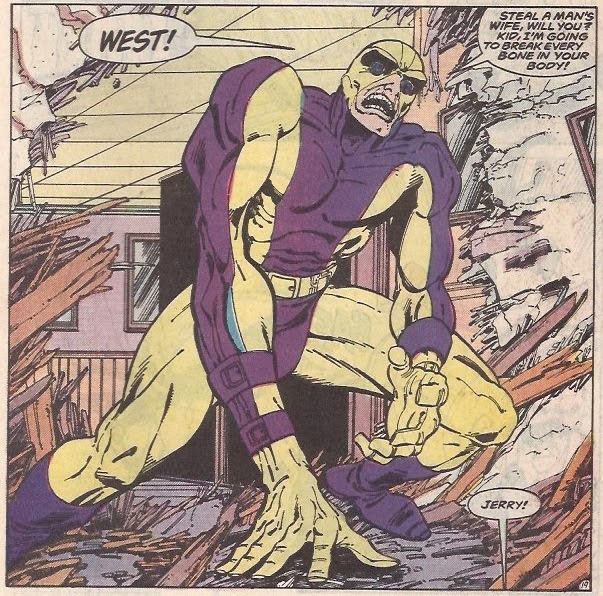
The plot of this narrative, which does not have a name but takes place in two issues titled “Speed McGee” and “Super Nature,” revolves around Wally being romantically involved with a married woman, and her completely insane husband’s misguided attempts to get revenge/win her back. She is Tina McGee, who the Flash met in a previous issue during some speed tests they conducted together in Utah. Her husband is Jerry McGee, a brilliant scientist whose most recent experiments have stolen his mind. He’s been researching steroids in an attempt to create new super-humans, and has even gone so far as to inject himself with the drugs, which have eaten away at his sanity. Now a rage-filled madman, Jerry finds himself losing Tina, who has become quite enamored of Wally since their initial encounter. Convinced that Wally is a threat to his marriage (which is essentially true) Jerry decides to do something about it, and creates a costume designed to regularly dose him with the experimental steroids and also uses various additional bits of sci-fi technology to further enhance his physical abilities. The result is a hulking, crazed beast of a man in purple-and-yellow spandex with super speed, ridiculous levels of strength, and a seemingly impenetrable tolerance for pain.

It is Jerry as a supervillain—the cover of issue #6 names him “Speed Demon” but nobody ever says that in-story so I’m just going to keep calling him “Jerry”—that provides the most impressive visuals. Jackson Guice (before he went by “Butch”) makes Jerry a truly horrific figure, his massive, warped body straining against the weight of its own might. When he bleeds, which is often, it is a viscous black, which may be partly thanks to colorist Shelley Eiber, but the sickeningly sticky texture, if not the dark hue, is certainly Guice’s work. In addition to his overstuffed size and shape, Jerry’s maniacal anger and over-confidence make him dominate every panel he’s in. He also dominates every fight, despite the Flash’s best efforts. No amount of high-speed punching is enough to even phase Jerry in his drug-enhanced state, so he trounces Wally a couple times, once to kidnap Tina back, and then later when he tries to murder his former boss, Dr. Bortz. Though Jerry doesn't succeed in getting Tina or killing Bortz, in neither case is it the Flash who actually foils his plans. No, it is Jerry’s own superpowers that thwart him, or rather his inability to keep them under control. When he snatches Tina and tries to run away with her, he accidentally charges full speed into a fuel depot, causing a massive explosion that, though Jerry survives, forces him to drop his wife. Later, the Flash tries to defend Bortz, so he and Jerry get into a fierce melee. Jerry quickly gets the upper hand, and is mere seconds away from snapping Wally’s spine when, all of a sudden, his body finally craps out on him after days of extra-strength steroids and reckless violence.

I’m quite fond of the idea of a supervillain who’s too powerful for his own britches. It’s pretty common for bad guys to seem impossible to beat at first, usually because this makes the hero’s eventual victory all the more satisfying. In this case though, Baron goes the opposite route, and I appreciate his commitment to making Jerry such a massive threat that the Flash never does figure out a way to save the day. Baron takes the common approach of creating an apparently insurmountable obstacle at the start of the story, but then surprises the reader by having the problem solve itself. The Flash is almost incidental to this tale, except that without him, Jerry would have no reason to become a ‘roided out super-lunatic. Also, Dr. Bortz might have died if the Flash was not around to defend him, though even that’s not for certain, since Bortz already had a weapon on hand specifically designed to deal with Jerry’s new powers. Having the Flash be such an insignificant player in his own book might turn some people off, but I don’t have a problem with it here because it fits with Baron’s general characterization of Wally as immature and inexperienced. He’s rash, he lacks forethought, he gets involved with a married woman eleven years his senior, he handles his newfound riches poorly, and so on. Failing to defeat Jerry goes right along with the rest of Wally’s shortcomings.

That’s the core of this narrative, and it’s a solid one. Baron and Guice construct Jerry as a convincingly terrifying new villain, and his brief, brutal story is atypical and artistically interesting enough to support the two issues it takes up. Where these comics fail to deliver, though, is in all the non-Jerry material. Baron can’t quite seem to strike a balance between the Jerry-vs.-Flash scenes and all the other storytelling that needs to take place. Wally’s scenes with Tina are consistently too short for their relationship to develop the way it ought to for this narrative to be at its best. Their romance is so new, their bond so thin, that without more room to see them get to know and care for one another, it’s hard to feel invested in them as a couple. This in turn makes the stakes seem lower, since the whole conflict is based on Wally and Jerry both wanting to be with Tina.

This is the most obvious example of Baron mismanaging things, because it’s a problem throughout the entire story, but there are other, more isolated instances as well. Wally’s dad shows up suddenly to crash at his son’s mansion with a flimsy-at-best explanation as to why. Then, once he’s settled in, the narrative forgets about him completely, and he’s not seen again for the duration of this story-line. Later, after Jerry’s first attack, Wally contacts his teammates in the Teen Titans to have them protect Tina, which they do for about three pages, even flying her out to Titans Tower. But almost as soon as she arrives, Tina decides she doesn't want to stay in the safe, secure environment if it means being apart from Wally, so he agrees to take her back, making the entire trip essentially pointless. It comes across as Baron feeling obligated to address why Wally isn't turning to his friends for help, rather than having a legitimate story reason for including them. The ending leaves a lot to be desired, too. While, as I said, I’m a fan of Jerry taking himself down, it does happen rather abruptly. Afterwards, there’s a rushed, jumpy final few scenes, hurriedly tying up the story’s loose ends before charging right into a teaser for the book’s next arc. It’s a bungled closing beat, not given the proper space to do everything it wants to do.

Basically, anything in this narrative not directly related to Jerry’s destructive (and self-destructive) streak is given the short shrift. Which is too bad, but better a lack of balance than a lack of anything interesting at all. Jerry is an intense, fascinating villain who brings some unusual and unexpected elements to this comic, and that on its own makes these issues worth reading. They’d be even more enjoyable if Baron could more deftly juggle all the balls he has in the air, but both he and Guice put their focus on a single character instead, making him memorable and immensely entertaining, but only at the rest of the tale’s expense.